Updated October 13, 2026 5:25 pm
In short
Nvidia’s softened DLSS 5 is set to debut in Hogwarts Legacy on November 5, with a smaller October model that will ship by default in future games and a faster Frame Generation mode in the Nvidia app beta.
- DLSS 5 will debut in Hogwarts Legacy on November 5 and in Where Winds Meet later next month.
- Nvidia has toned down the technology after criticism that earlier demos altered faces too aggressively.
- The October model update cuts footprint and VRAM use while improving speed on RTX 50-series GPUs.
- A new Nvidia app beta adds a faster Frame Generation mode with minor image-quality trade-offs.
Update — October 13, 2026 5:25 pm
Nvidia has now set a firmer debut date for the toned-down DLSS 5 rollout in Hogwarts Legacy: November 5. Where Winds Meet is still expected later next month.
The company also says the lighter October model will be the default in future DLSS 5 games, not just in the early titles shown so far. Nvidia is still targeting a 24% smaller footprint, roughly 118 million parameters, and 20% less 4K VRAM use.
On the app side, Nvidia says the faster Frame Generation mode now uses a lighter algorithm across Frame Gen, Multi Frame Gen and Dynamic Multi Frame Gen, with only minor image-quality trade-offs.
Nvidia is about to bring DLSS 5 to Hogwarts Legacy and Where Winds Meet, but the company is now marketing a much more restrained version of the technology than the flashy AI demo it showed earlier this year. The update matters because it signals Nvidia is adjusting its gaming AI pitch after criticism that DLSS 5 was changing characters and scenes too aggressively.
The company is pairing that rollout with a performance-focused update that makes the neural rendering system lighter and faster, while also improving Frame Generation in its Nvidia app beta for RTX 40- and 50-series GPUs. Together, the changes suggest Nvidia is trying to make DLSS 5 easier for developers to adopt and less alarming for players.
What changed in Nvidia’s DLSS 5 strategy?
Nvidia is presenting DLSS 5 as a more conservative and developer-controlled feature set than the version it first showed earlier in 2026. In the company’s earlier demonstration, the technology drew criticism because it appeared to alter character faces and environmental details in ways that felt too dramatic for many gamers.
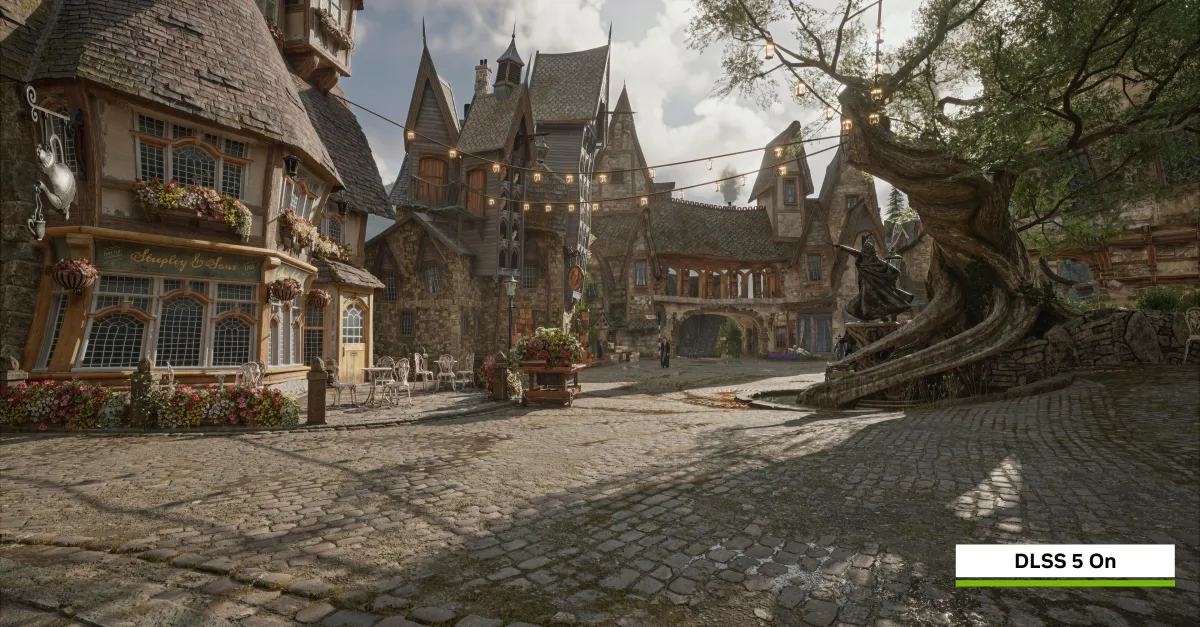
In the latest comparison images Nvidia released, the effect is far subtler. Facial changes are much less obvious, and the visual differences in the surrounding game world appear more restrained as well. That shift suggests Nvidia has tuned the model to preserve the original art style more faithfully, while still using AI to enhance image quality and rendering efficiency.
Nvidia has said developers retain detailed artistic control over how DLSS 5 is used, meaning studios decide how far the technology goes in each game.
That point matters because DLSS is not just a graphics filter. It is part of the rendering pipeline, and decisions about its implementation can affect everything from character appearance to fine environmental textures. A more cautious rollout may help Nvidia convince game studios that the feature can improve performance without fundamentally changing how a game looks.
How will DLSS 5 debut in Hogwarts Legacy and Where Winds Meet?
DLSS 5 will first appear in Hogwarts Legacy on November 5, followed by Where Winds Meet later next month. Those games will serve as key test cases for how the new system behaves outside of Nvidia’s earlier promotional material.
Hogwarts Legacy is especially notable because it is a visually detailed, widely played title with a large audience that will quickly notice any changes to lighting, character detail, or facial presentation. If Nvidia’s toned-down approach holds up in a live game, it could help reset the conversation around how much AI-based rendering should visibly alter a scene.
Where Winds Meet, which follows shortly after, gives Nvidia another opportunity to show consistency. A staggered launch also allows the company to gather feedback from one release before the next arrives.
| Game | DLSS 5 release timing | Why it matters |
|---|---|---|
| Hogwarts Legacy | November 5 | First major public debut for the toned-down model |
| Where Winds Meet | Late next month | Second test of DLSS 5 in a live commercial game |
| NBA 2K27 | October 16 | First game to ship the updated, lighter model by default |
Why is Nvidia reducing DLSS 5’s footprint?
Nvidia is shrinking the model because it wants DLSS 5 to run faster and use fewer resources, especially on newer hardware where the company wants to show the benefit of its AI-first graphics approach. The October update reduces the neural rendering system’s size by 24 percent, bringing it to roughly 118 million parameters, while cutting 4K VRAM usage by 20 percent.
According to Nvidia, the revised model should also be twice as fast on RTX 50-series GPUs and on the upcoming RTX Spark laptops. That is important because rendering systems compete for both memory and compute, and lowering the workload can make it easier for developers to enable DLSS features without compromising frame delivery or image stability.
In practical terms, a smaller model can mean fewer performance costs and smoother operation in demanding games. For users, that could translate into better frame rates with less of the stutter or latency risk that can come from heavier AI processing.
The first title to ship with the new model by default will be NBA 2K27 on October 16, giving Nvidia an earlier real-world showcase before the broader wave of game integrations arrives.
How does the October update affect RTX 50-series GPUs?
The October update is designed to be most noticeable on RTX 50-series cards, where Nvidia says the DLSS 5 system should run about twice as fast. That claim positions the newest GPUs as the ideal platform for the company’s next step in neural rendering, while also creating a clearer performance story for buyers comparing generations.
The update is also intended for the upcoming RTX Spark laptops, which means Nvidia is trying to extend the same AI rendering gains into mobile systems. That could make DLSS 5 more attractive in thin-and-light gaming machines where power and thermal limits are tighter.
What else is changing in Nvidia’s app beta?
Nvidia has also pushed a beta update for its Nvidia app that adds a faster performance mode for Frame Generation on RTX 40- and 50-series GPUs. The company says the revised AI model uses a lighter algorithm to boost frame rates for Frame Generation, Multi Frame Gen, and Dynamic Multi Frame Gen.
The trade-off, Nvidia says, is that image quality may take a slight hit. But the company claims the upside is significant enough that performance mode could be up to 35 percent faster.
That balancing act reflects the broader challenge facing graphics companies using machine learning in real time: every gain in speed can risk some reduction in fidelity. Nvidia appears to be betting that many players will accept a small visual compromise if the result is a smoother experience.
Why does Frame Generation matter for PC gaming?
Frame Generation matters because it can increase apparent frame rates without requiring the GPU to render every frame traditionally. For players, that can improve responsiveness and visual smoothness, especially in demanding games that already push hardware close to its limits.
By extending the feature to Multi Frame Gen and Dynamic Multi Frame Gen, Nvidia is deepening its effort to make AI-driven frame synthesis a standard part of the gaming stack rather than a niche feature. The company’s latest app beta suggests it wants these tools to be easier to use and less taxing on hardware.
How did gamers react to the original DLSS 5 demo?
Many players reacted cautiously, and some were openly skeptical, when Nvidia first revealed DLSS 5 earlier in the year. The concern was not just about whether the system worked, but about what it was doing to the look and feel of games.
In the original showcase, some viewers felt character faces were being altered too aggressively, leading to complaints that the technology resembled generative AI applied too broadly to visual assets. The backlash was amplified by the fact that games are a medium where art direction, consistency, and authorial control matter a great deal to audiences.
Nvidia’s latest examples are clearly an effort to cool those concerns. Instead of dramatic face transformations, the company is now emphasizing subtle visual improvements, closer to traditional upscaling and reconstruction features that gamers are already familiar with.
When Nvidia first demonstrated the technology, the reaction from parts of the gaming community suggested the company needed to prove DLSS 5 could improve graphics without rewriting the look of a game.
What this means for developers and publishers
For game studios, the most important message is that DLSS 5 will likely be judged not only on performance gains but on how well it respects each game’s original art style. Nvidia’s emphasis on artistic control is a sign that the company knows developers are sensitive to any technology that could visually reshape their work.
Studios also care about technical overhead. A lighter model with a smaller memory footprint is easier to integrate, easier to test, and less likely to interfere with other rendering systems. That could make DLSS 5 more appealing for future game launches, especially on PC where hardware diversity creates extra support challenges.
Publishers, meanwhile, will be watching player reaction. If the first games using DLSS 5 receive praise for image quality and smoother performance, the technology could become a selling point. If the model still feels too intrusive, however, developers may choose to limit how widely they deploy it.
Timeline: Nvidia’s DLSS 5 rollout
The following timeline summarizes the key milestones Nvidia has laid out so far:
- Earlier in 2026: Nvidia first showcased DLSS 5, drawing criticism from some gamers over visible image changes.
- October 16: NBA 2K27 becomes the first game to ship the updated DLSS 5 model by default.
- Later in October: Nvidia’s Nvidia app beta gains a faster performance mode for Frame Generation.
- November 5: Hogwarts Legacy gets DLSS 5.
- Late next month: Where Winds Meet adds support for the technology.
Why Nvidia’s pivot matters now
Nvidia’s revised approach shows that the company is still trying to define what AI should look like in games. The original DLSS 5 demo suggested a bold, highly visible use of machine learning in rendering. The new rollout points toward a more practical strategy: lower overhead, subtler visuals, and closer alignment with the way gamers expect their favorite titles to look.
That shift could prove crucial as Nvidia pushes deeper into AI-powered graphics. Gamers tend to embrace features that improve performance without changing the underlying identity of a game. By toning down DLSS 5, Nvidia may be trying to meet that expectation before a wider launch turns technical debate into a lasting reputational issue.
For now, the company’s message is clear: DLSS 5 is still central to its gaming roadmap, but it is being introduced with a lighter touch. The real test will come when players see it inside full releases rather than side-by-side marketing images.
Key details at a glance
| Item | Details |
|---|---|
| Technology | DLSS 5, Nvidia’s AI-based neural rendering system for games |
| First major game rollout | Hogwarts Legacy on November 5 |
| Second rollout | Where Winds Meet later next month |
| Model update | 24% smaller footprint, about 118 million parameters |
| VRAM impact | 20% lower 4K VRAM usage |
| Performance claims | Up to 2x faster on RTX 50-series GPUs; up to 35% faster Frame Generation performance mode |
As Nvidia moves DLSS 5 from demo stage to real games, the company is clearly trying to prove that AI can enhance PC graphics without overwhelming them. The next few launches will show whether that compromise satisfies both players and developers.
Frequently asked questions
When will DLSS 5 launch in Hogwarts Legacy?
DLSS 5 will launch in Hogwarts Legacy on November 5. Nvidia is using the game as one of the first major public deployments of its updated neural rendering system.
Why did Nvidia tone down DLSS 5?
Nvidia toned down DLSS 5 after its earlier demo drew criticism for making visible changes to character faces and some game details. The newer version is meant to be subtler and more in line with a game’s original art direction.
What improvements does the DLSS 5 October update bring?
The October update makes DLSS 5 smaller and faster, cutting the model’s footprint by 24 percent and reducing 4K VRAM use by 20 percent. Nvidia says it should run twice as fast on RTX 50-series GPUs and future RTX Spark laptops.
Which games will use the updated DLSS 5 model first?
NBA 2K27 will be the first game to ship the updated DLSS 5 model by default on October 16. Hogwarts Legacy and Where Winds Meet will follow as the next major game integrations.
What is new in Nvidia’s app beta for Frame Generation?
Nvidia’s app beta now includes a performance mode for Frame Generation on RTX 40- and 50-series GPUs. Nvidia says the lighter AI algorithm can make the feature up to 35 percent faster, though it may slightly reduce image quality.