In short
Kevin O’Leary’s massive Utah AI data center proposal ran into intense local opposition after residents learned the project had advanced largely out of public view. The backlash over water, power, secrecy and local control helped stall the plan and exposed growing resistance to AI infrastructure.
- The Utah project was pitched as one of the largest AI data centers ever proposed.
- Many local residents and county officials learned about it only after state-level approvals had advanced.
- Opposition spread quickly across ideological lines, driven by water, power and process concerns.
- The backlash severely damaged the project’s momentum and became a broader test case for AI infrastructure politics.
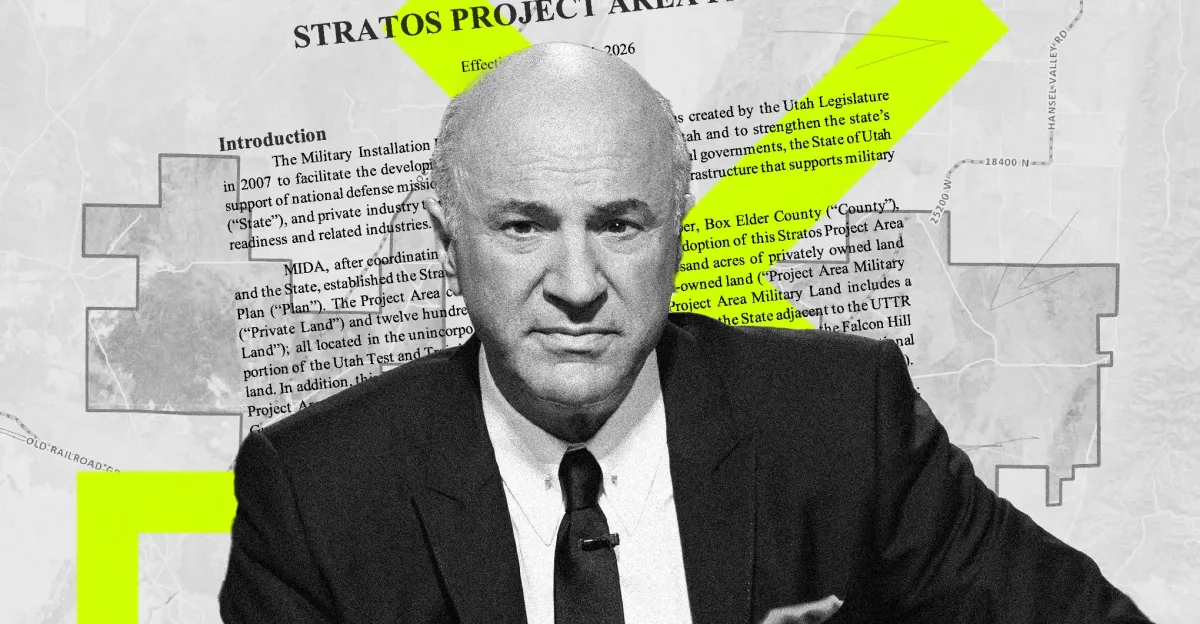
Utah residents and county officials pushed back hard against Kevin O’Leary’s proposed Wonder Valley data center, helping stall what was billed as a nine-gigawatt AI campus on 40,000 acres in remote Box Elder County. The backlash mattered because the project became an early test of whether the AI infrastructure boom can outrun local opposition, water concerns, and the political limits of secretive dealmaking.
What began as a glossy promise of the world’s biggest data center quickly turned into a case study in how large AI projects can unravel when communities feel bypassed. Reporting on the plan revealed a process that unfolded largely among state officials, developers, and landowners before most local residents even knew it existed — and by the time the public found out, the political damage was already done.
The project, known technically as Stratos but more widely branded as Wonder Valley, was presented by O’Leary as a generational investment in Utah’s future. Instead, it became a lightning rod for criticism over transparency, water use, tax incentives, local control, and the broader social cost of AI’s infrastructure buildout. In the end, the size of the backlash appears to have slowed or wounded the project so severely that its original momentum evaporated.
What happened to Kevin O’Leary’s Utah data center plan?
Kevin O’Leary’s Utah data center plan ran into intense local resistance after residents, county leaders, and activists learned that a massive AI campus had been advancing with little public awareness. The project’s early progress depended on state-level approvals and private negotiations, but once the details became public, opposition spread quickly and the project lost momentum.
The plan called for a sprawling campus across roughly 40,000 acres in a remote part of Utah, with a power demand described as nine gigawatts — more than double the average electricity use of the entire state. For many residents, those numbers were not just large; they were alarming enough to frame the project as an existential risk to water supplies, land use, and local governance.
O’Leary, known to many Americans from Shark Tank, made the project public before most local officials had even been properly briefed. That timing became one of the central reasons the backlash intensified. By the time county leaders were brought into the process, the public conversation had already shifted from possibility to anger.
How the project moved from secret talks to public conflict
The project advanced first through state channels, not through a broad local planning process. According to the reporting, O’Leary began discussions with Utah officials early in the year, and those talks eventually reached the Military Installation Development Authority, or MIDA, a state agency with unusual powers over land use and development in certain project areas.
MIDA is designed to support projects tied to military or adjacent economic development, but its authority can also streamline permitting and override some local hurdles. In practice, that made it appealing to developers seeking speed, certainty, and favorable tax treatment. In this case, however, the agency’s involvement became one of the most controversial aspects of the deal.
The county government that would ultimately be affected by the project did not receive the same early attention. By the time the county learned how far the proposal had advanced, state officials were already pushing for approval. That sequence — state first, county later, public last — fueled a sense that the deal had been engineered behind closed doors.
Why did secrecy matter so much?
Secrecy mattered because local residents believed they were being asked to live with the consequences of a project they had not been allowed to scrutinize from the start. In many communities, a large industrial project can still survive scrutiny if residents believe they were consulted honestly. Here, many felt the opposite: that the outcome was being prepared before their voices entered the room.
That procedural anger cut across ideological lines. Environmental advocates worried about water and land use. Conservative residents objected to state intervention and perceived overreach. Others focused on AI-related surveillance fears, the size of the tax incentives, or simply the scale of the project itself.
Because the project’s announcement came after significant groundwork had already been laid, residents did not experience it as a proposal. They experienced it as a surprise.
Why did Wonder Valley trigger such a broad backlash?
Wonder Valley triggered broad backlash because it combined several of the most politically explosive elements in one package: a celebrity developer, an enormous energy load, a sensitive water setting, and a process that many locals saw as undemocratic. The project’s size made it easy to oppose and difficult to defend.
Unlike some industrial projects that can win support by promising jobs and revived manufacturing, this one offered a much murkier bargain. Data centers often generate relatively few permanent jobs compared with the scale of land, water, and power they consume. That made it harder for supporters to sell the project as a clear local win.
Utah’s context mattered too. The proposed campus sat near a region already under pressure from drought and from concern over the shrinking Great Salt Lake. Even if developers insisted the project would not draw down the lake’s water supply, many residents did not trust those assurances.
Local critics, according to the reporting, argued that the project was pushed through without meaningful notice, leaving communities feeling excluded from decisions that would reshape their county.
Who joined the opposition?
The opposition included an unusually wide coalition. Activists, rural residents, conservative groups, water-preservation advocates, and people with environmental concerns all found common cause against the project. That coalition gave the resistance unusual political strength.
One reason the movement gained traction so quickly was that “data center” had already become a familiar flashpoint nationally. People hearing about the project did not need an explanation of why a huge server campus might be controversial. They already associated data centers with power demand, noise, water consumption, tax incentives, and opaque corporate planning.
The result was a coalition that did not need to be ideologically coherent to be effective. It only needed a shared target.
How local residents turned a planning dispute into a political problem
Local residents turned a planning dispute into a political problem by showing up early, loudly, and in numbers large enough to unsettle officials. Meetings that were supposed to handle routine approvals instead became forums for anger, questions, and organizing.
The backlash was not just about the project itself. It was also about the process by which the project was revealed. In many accounts from the area, people described learning about the data center from local reporting, Facebook, conversations at stores, and word of mouth. That delay hardened suspicion.
Once residents realized how late they had been informed, the issue stopped being a technical land-use matter and became a test of who gets a say in the future of a rural county. That broader political framing helped transform opposition from scattered frustration into organized resistance.
What role did media and social platforms play?
Media and social platforms played a major role because they spread the story far beyond the tiny group of people who had known about it from the beginning. Local coverage brought the issue into the open, while Facebook and similar platforms made it easy for residents to amplify concern and coordinate attendance at public meetings.
In the age of viral local backlash, a project like Wonder Valley can no longer remain a narrow zoning issue. Once it becomes a symbol of AI’s physical footprint, it can attract national attention and turn into a proxy fight over development, governance, and technology policy.
How did Utah’s AI data center fight resemble the Foxconn saga?
It resembled the Foxconn saga in the way both projects were shaped by state-level competition, boosterism, and big promises that outpaced public understanding. In both cases, officials framed the project as an economic opportunity before the communities most affected had a real chance to weigh in.
But there was a critical difference. Foxconn was widely seen as an overhyped manufacturing dream that never fully materialized. The Utah data center was more plausible as a physical project — data centers are real, and many are being built — but that did not make it politically easier. If anything, the realism of the buildout made the potential consequences feel more immediate.
The comparison also shows how the technology sector has evolved. Where Foxconn tapped into hopes of industrial rebirth, Wonder Valley collided with fears about AI’s scale and power use. Instead of optimism, the emotion driving opposition was distrust.
| Key fact | Wonder Valley / Stratos | Why it mattered |
|---|---|---|
| Developer | Kevin O’Leary-backed project | Celebrity backing raised the profile and scrutiny |
| Reported size | 40,000 acres | Made it one of the most ambitious data center proposals in the U.S. |
| Power demand | 9 gigawatts | Raised alarms over electricity supply and grid impact |
| Location | Box Elder County, Utah | Remote rural setting amplified concerns about process and water |
| Public reaction | Rapid, bipartisan backlash | Helped stall the project and erode political support |
Why are data centers becoming a political flashpoint?
Data centers are becoming a political flashpoint because they are essential to AI, but their local costs are increasingly visible and difficult to ignore. They need enormous amounts of power, often significant water resources, and large tracts of land. Those demands can collide with community values almost immediately.
At the same time, data centers often promise relatively modest direct employment compared with the industrial footprint they leave behind. That mismatch has become a recurring source of resentment, especially when companies seek tax breaks or expedited approvals.
The Utah case shows that the backlash is no longer confined to traditional environmental groups or urban activists. It can now include rural conservatives, local property owners, and people who simply do not want a megaproject imposed on their county without adequate consultation.
What does this mean for the AI buildout?
It means the AI buildout may face a constraint that money alone cannot solve: local democracy. Companies can buy land, hire lobbyists, and promise jobs, but they cannot easily buy trust once communities believe they were shut out.
That does not mean data center construction will stop. Far from it. But it does suggest that future projects may need earlier disclosure, clearer community engagement, more realistic environmental planning, and more honest discussion about the trade-offs involved.
For the tech industry, the lesson from Utah is blunt: infrastructure at AI scale is not just a technical challenge. It is a political one.
What the Utah fight reveals about the future of AI infrastructure
The Utah fight reveals that the next phase of AI expansion will be shaped as much by local resistance as by corporate ambition. For years, the industry has treated infrastructure as a matter of permitting, capital, and electricity. This story shows that people living near proposed sites are now an equally important force.
The more the public learns about AI’s physical dependencies — warehouses full of servers, huge power contracts, water use, and land conversion — the more likely it is that large projects will face scrutiny before construction begins. The industry can no longer assume that a remote site is an empty site politically.
Wonder Valley also demonstrates the importance of narrative. A project announced as “the world’s biggest” may generate headlines, but that same superlative can make it easier for opponents to rally. Big claims create big targets.
In Utah, the combination of secrecy, scale, and symbolism turned what might have been a routine development fight into a broader referendum on how AI infrastructure should be approved, who gets to decide, and whether local communities are expected to absorb the costs in silence.
Timeline: how the Wonder Valley fight unfolded
The project’s path from private talks to public controversy happened quickly once the final approvals started moving. The timeline below shows the key turning points.
| Period | Event | Significance |
|---|---|---|
| Early January | Initial state-level discussions begin | The project starts moving before local governments are fully informed |
| February to March | Negotiations continue through state channels and MIDA | Approvals advance while public awareness remains low |
| Late March | County officials begin hearing rumors | Local government realizes the project is already far along |
| Late April | Public meetings and local reporting bring the plan into the open | Backlash begins to intensify rapidly |
| Late April, two days later | MIDA approves the project area | Approval comes amid escalating controversy |
| Afterward | Residents organize protests and political pressure builds | The project’s momentum is sharply reduced |
Where the project stands now
The project appears severely weakened compared with its initial pitch. Whether it can still move forward remains uncertain, but it no longer has the same political momentum or public legitimacy it seemed to have at the outset.
That shift is important beyond Utah. It suggests that even the most aggressively marketed AI infrastructure projects may be vulnerable if they are perceived as secretive, overbuilt, or misaligned with local interests. The scale that once helped the project dominate headlines may now be part of the reason it stalled.
For residents, the outcome is a reminder that organized local opposition can still influence major development decisions. For the tech industry, it is a warning that the AI boom is running into a real-world barrier that cannot be softened with press releases or celebrity endorsements.
As the reporting makes clear, the central issue was not simply whether a data center could be built in Utah, but whether it could be forced through without the public ever feeling properly informed.
Why this story matters beyond Utah
This story matters beyond Utah because it may preview what happens when AI infrastructure collides with local political realities across the country. More companies will seek land, power, and water in rural places. More communities will ask why they were not told sooner. More projects may become symbols of a technology industry that wants speed but not scrutiny.
Wonder Valley was never just about Kevin O’Leary. It was about the changing relationship between AI firms and the communities that host their infrastructure. The Utah backlash shows that the future of AI may depend not only on chips and servers, but on whether the people living next door believe they were treated fairly.
In that sense, the Utah fight is not an outlier. It is a preview.
And it suggests that the most formidable obstacle to the AI buildout may not be capital, regulation, or competition. It may be the simple, stubborn fact that local residents still get a vote.
Key points at a glance
- Kevin O’Leary-backed plans for a huge Utah AI data center ran into fierce local resistance.
- The project was advanced largely through state-level channels before many residents and county officials knew about it.
- Concerns centered on water, power use, tax incentives, secrecy, and local control.
- The backlash drew an unusually broad coalition, including conservatives, environmental advocates, and anti-tax activists.
- The project’s momentum appears to have been badly damaged, highlighting a growing challenge for AI infrastructure.
Frequently asked questions
What was Kevin O’Leary’s Utah data center project?
It was a proposed massive AI campus in Utah, known as Stratos and branded as Wonder Valley, that was pitched as the world’s largest data center buildout. The plan called for roughly 40,000 acres and about nine gigawatts of power, making it one of the most ambitious infrastructure projects tied to AI.
Why did Utah residents oppose the data center?
They opposed it because of concerns about water use, electricity demand, tax breaks, and the way the project was handled. Many residents also felt blindsided by a process that advanced through state channels before county officials and the public were properly informed.
How did the project gain approval before the backlash?
It advanced through Utah’s Military Installation Development Authority, a state agency with special development powers. That allowed the project to move forward quickly at the state level, but the county government that needed to approve it was brought in late, which helped fuel anger once the plan became public.
Did the opposition actually slow the project down?
Yes. The backlash appears to have seriously weakened the project’s momentum. After residents, activists and county leaders pushed back, the proposal lost the political and public support it seemed to have when O’Leary first promoted it.
Why is this story important for the AI industry?
It shows that AI infrastructure projects can run into powerful local resistance even when they are technically feasible. The Utah fight is a warning that secrecy, huge energy needs and weak community engagement can derail major data center plans.