Updated August 30, 2026 12:25 pm
In short
EDM producers are escalating a broader AI authenticity crackdown, now citing new examples of suspected Suno-assisted copying while the genre’s trust problem deepens.
- EDM artists are publicly calling out suspected AI-made tracks and videos.
- Suno has become a central target in the growing debate over synthetic music.
- AI-generated songs are already finding chart exposure, label interest and revenue.
- Musicians say the biggest concerns are authenticity, copyright and lost income.
Update — August 30, 2026 12:25 pm
The updated report adds a new example that the anti-AI camp says fits the pattern: Nihil Young specifically pointed to Josh Fawaz’s “Like a Prayer” cover as evidence of Suno-style copying and remixing.
It also says some musicians accused of using AI have denied it at first and only acknowledged it after growing public pressure, adding another wrinkle to the scene’s trust problem.
Beyond the individual accusations, the new material frames Harris’s campaign as part of a broader credibility crisis in online music, where listeners are increasingly unsure what is human-made and what is generated.
Update — August 29, 2026 3:53 pm
The updated report adds a new example of the kind of material fueling the backlash: Nihil Young specifically cited Josh Fawaz’s “Like a Prayer” cover as a case he believes reflects Suno-style copying and remixing.
It also says some artists accused of using AI have denied it publicly until pressure mounted, and notes that Harris’s criticism is now being framed as part of a broader trust problem across online music.
Electronic dance music artists are increasingly accusing peers of passing off AI-generated tracks as human-made, and the backlash is becoming a new kind of callout culture across the scene. The debate matters because the flood of synthetic songs is reshaping how fans judge authenticity, how artists earn money, and how streaming platforms label music.
What began as scattered suspicions has turned into a more organized effort by producers and DJs who say they are spotting the telltale sounds and visuals of generative tools such as Suno in tracks, videos and social posts. In interviews, two musicians at the center of that effort argued that AI music is not just a creative nuisance but a direct threat to working artists, especially in fast-moving genres like EDM where experimentation and trend-chasing already blur the line between novelty and imitation.
At the same time, AI-generated music is proving difficult to contain. Songs made with these tools are surfacing on streaming services, charting on social platforms, attracting label attention and, in some cases, generating serious revenue. That tension — between a growing market for synthetic music and a rising movement of artists trying to expose it — is now one of the clearest fault lines in the modern music industry.
Why EDM has become a front line in the AI music debate
EDM is especially vulnerable to AI disruption because it is built on digital production, heavily processed vocals, and a culture that rewards constant output. Producers already work inside software-heavy environments, so listeners may have a harder time distinguishing carefully crafted human tracks from those assembled by generative systems.
That makes the genre a natural testing ground for AI music tools — and a natural battleground for the people who oppose them. When tracks appear with polished beats, generic drops and synthetic-sounding vocals, some listeners hear an emerging subgenre. Others hear evidence of stolen training data and stripped-out human authorship.
For many artists, the dispute is not only aesthetic. It is also about whether musicians who spent years learning the craft can still compete with a system that can produce a passable track in seconds.
Who is Max “H4RRIS” Harris, and why is he speaking out?
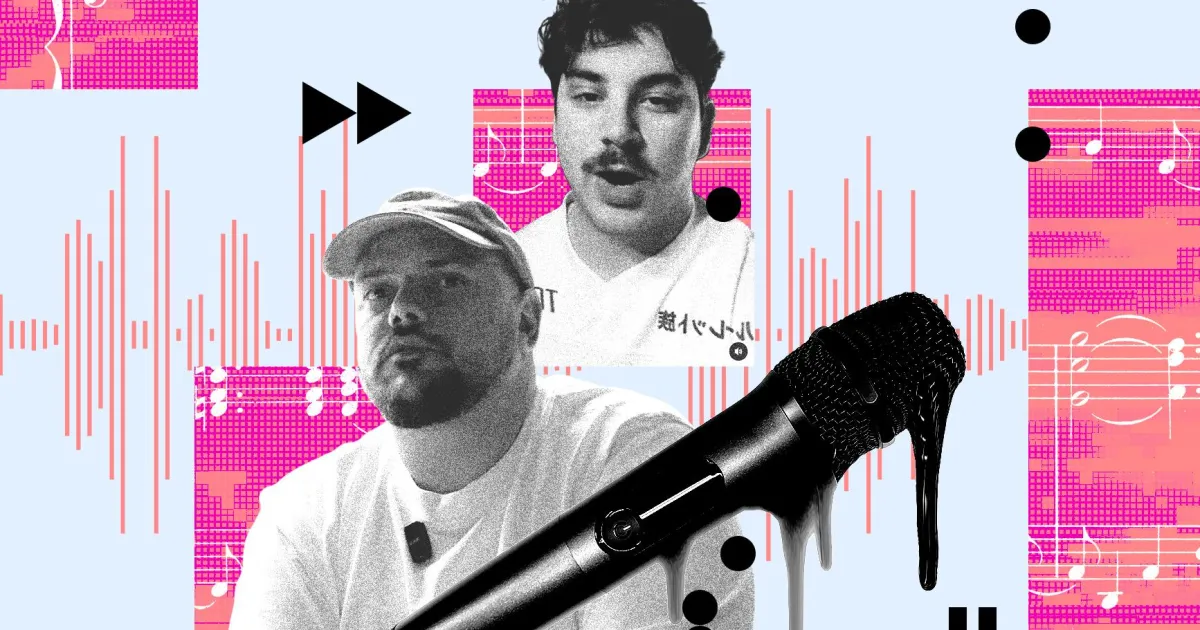
Max Harris, a 26-year-old EDM producer who performs as H4RRIS, has become one of the more visible voices in the anti-AI side of the argument. He has been posting videos that accuse certain accounts of trying to disguise AI-made music as the work of real musicians.
Harris, who is originally from Maine, said he views AI music as a shortcut that reduces art to a product. In his view, authentic music comes from people making deliberate choices based on experience, taste and emotion rather than from software stitching together borrowed patterns.
Harris described AI-generated music as a decoy form of art, saying the technology lets people repurpose real creative work and present it as something original. He also argued that the main incentive for AI boosters is profit, not artistic expression.
He said he does not regard machine-made tracks as art at all, and he believes they have not meaningfully advanced creativity. Instead, he sees them as a way to extract value from existing music without doing the difficult work of writing, arranging and mixing.
Harris also pointed to the labor behind a finished EDM track. His production setup includes Ableton Live, a Novation Launchkey 49 keyboard, Ableton Push 3, a Launchpad X, analog synths, Serum, Diva and Kontakt — but he stressed that the tools themselves are not the point. The real work, he said, is the chain of judgments a producer makes from the first idea to the final mix.
How Harris says he spots AI songs
Harris says several sonic clues often give away generative music. One of the most common, in his view, is a thin hissing quality that can run through a track. Another is the way vocals and melodic parts seem to stutter in sync, as if the song’s layers were not fully separated during generation.
He believes those quirks reveal how audio models work under the hood: by learning from huge sets of songs and reconstructing new material from statistical patterns rather than human intention. To Harris, the result often sounds like a composition that does not follow the instincts a trained producer would naturally use.
He has specifically pointed to songs by MANSA and by Danny and Ian Asher as examples of what he sees as AI-assisted EDM. In both cases, public proof has not been established, and the artists have not publicly confirmed generative use. But Harris’s willingness to make the accusation reflects a broader atmosphere of distrust that has developed around online music.
Why Suno has become a lightning rod
Suno, the AI music startup, came up repeatedly in the reporting on this trend because many artists believe its tools have lowered the barrier to flooding the internet with synthetic songs. Harris says the platform’s output often has distinct audio artifacts that make it easier for trained ears to recognize.
He also argues that some Suno users are doing more than merely prompting a model for a fresh idea. In his view, the bigger problem is that people are feeding in copyrighted tracks, asking the system to remix them, and then presenting the results as original work.
Harris said he has seen people upload copyrighted songs and have AI remix them, which he considers a form of theft disguised as creativity.
That concern is not limited to EDM. As generative music tools become more mainstream, the same tools that help hobbyists make demos quickly can also be used to imitate recognizable voices, recycle melodies and flood platforms with low-effort uploads.
How visuals can expose AI music
Sometimes it is not the sound alone that raises suspicion. Harris and other observers say the videos posted alongside AI tracks can make the giveaway more obvious.
He cited evangelical Christian AI persona Lionsaddle, whose content appears to include visual glitches such as disappearing fingers. He also pointed to the highly polished, overly glossy look of videos from Christian house musician Midnite Manna, which he says resemble the flat, synthetic quality commonly described as AI slop.
In the current environment, a track, image package and account history all matter. Artists who are not using AI say they are forced to defend not only what they hear, but what they see.
How Nihil Young joined the fight
Another musician helping drive the callout culture is Nihil Young, a 39-year-old Italian turntablist and producer. Young said his Threads posts about Suno and AI music initially inspired Harris to begin making his own videos.
Young said he has watched newcomers rise quickly in the EDM space after releasing tracks that he believes were created with AI tools. He said that pushed him to speak out even though he does not usually participate in online pile-ons or public disputes.
Young argued that some AI-generated songs appear to be built by uploading copyrighted music, including major-label material, into Suno and asking the system to generate something new from it.
He said he views that process as ethically unacceptable because it can convert an artist’s entire catalog into raw material for machine-made knockoffs. In his telling, if the same approach can be used on a superstar like Madonna, then it can also be used on smaller musicians who have far fewer resources to fight back.
Young said the backlash to his posts was intense. He claimed he faced hacking attempts, harassment from AI defenders and what appeared to be fake follower boosts aimed at undermining his credibility by making his Spotify numbers look suspicious. Those attacks, he said, made him reconsider how loudly he should keep speaking.
Why the backlash hit Young so hard
Young is not just a commentator; he is also a working professional whose income depends on music production. He said AI has already affected that work directly by reducing demand for human mixing and mastering services.
Before scaling back his callouts, Young said he had done audio work for major labels including Sony Music, Warner and Universal. Losing clients in the early wave of AI adoption, he said, made the threat feel immediate rather than theoretical.
He also said having a young daughter has sharpened his concerns about what kind of creative economy is being built. For him, the issue is not only whether AI tracks sound convincing, but whether an entire ecosystem of musicians, engineers, designers and session artists can survive if synthetic content becomes the default cheap option.
What the table shows about the AI music timeline
The controversy has built in stages, from viral novelty to monetized disruption. The following timeline highlights the recent moments that helped turn AI music from a curiosity into a mainstream industry issue.
| Time period | Event | Why it matters |
|---|---|---|
| Summer 2024 | AI-generated “BBL Drizzy” gains traction and is used in a viral producer-versus-rapper moment | Shows AI music can break into mainstream pop discourse |
| Last summer | “A Million Colors,” a Suno-made song by Vinih Pray, reaches TikTok’s Viral 50 | Demonstrates that synthetic music can spread quickly on social platforms |
| Recent months | EDM artists begin publicly accusing peers of using Suno and other tools | Signals an emerging peer-policing culture around authenticity |
| 2025 | Kapwing estimates the top AI music creators on Spotify and YouTube earn more than $6 million combined | Shows the business incentive for making synthetic music |
| Recent industry moves | Hallwood Media signs AI avatar Xania Monet to a reported $3 million deal | Suggests labels are willing to invest in AI-driven acts |
How AI tracks are moving from novelty to business
The rise of AI music is no longer limited to anonymous uploads and novelty experiments. It is now intersecting with charts, licensing, labels and marketing strategies.
A modern example came in the Drake versus Metro Boomin feud, when Metro Boomin used an AI-generated beat built from comedian King Willonius’ “BBL Drizzy” as part of a public diss-track moment. The track itself became a cultural event, and Drake later rapped over the beat on Sexyy Red’s “U My Everything,” which climbed to No. 44 on the Billboard Hot 100.
Elsewhere, AI-created songs have found chart visibility in less conventional places. Vinih Pray’s Suno-made “A Million Colors” reached TikTok’s Viral 50, while AI acts Breaking Rust and Cain Walker appeared on Billboard’s Country Digital Song Sales chart. These placements may not prove broad artistic acceptance, but they do prove synthetic music can penetrate the commercial system.
Meanwhile, Hallwood Media’s reported signing of AI avatar Xania Monet for $3 million signaled something even more consequential: parts of the industry are willing to treat AI personas as bankable talent.
How much money is at stake?
Kapwing’s estimate that the most-followed and most-streamed AI music creators on Spotify and YouTube brought in more than $6 million in 2025 suggests the economics are no longer marginal. Even if those numbers are difficult to verify independently, they point to a real revenue opportunity.
Deezer has also said that AI-generated songs now make up more than half of new uploads on the platform. If accurate, that would indicate the issue is not just a niche concern among purists. It is a volume problem that could reshape discovery, recommendation systems and catalog valuation.
As more AI content arrives, even listeners who do not care whether a song was generated may find it harder to avoid synthetic music entirely.
Can listeners actually tell the difference?
Often, no — at least not immediately. That is part of what makes the current debate so hard to resolve.
Streaming platforms are beginning to label some AI songs more clearly, but that has not eliminated confusion. Many listeners say they cannot reliably distinguish human-made music from AI-assisted tracks unless they are already familiar with the artist or hear obvious artifacts.
Young believes the difference becomes more obvious on good headphones, but he also thinks the average listening habit has changed. People often hear music through phone speakers, in playlists running in the background, or while multitasking rather than sitting down to really listen.
Young said many listeners consume music passively, almost like fast food, which makes it easier for synthetic tracks to pass as ordinary background sound.
That observation matters because a large share of music discovery now happens in low-attention environments. If a track sounds good enough for a workout, a stream, or a short-form clip, many listeners may never ask how it was made.
What makes AI music so hard to police?
The biggest obstacle is certainty. Unless a creator admits using AI, or there is some other direct evidence, it is difficult to prove how a track was made.
That leaves fans, producers and platform moderators with imperfect tools: visual clues, sonic hunches, metadata, and in some cases detection software that has not yet become a dependable standard. Even when suspicion is strong, accusations can be wrong.
That uncertainty fuels both sides of the argument. Critics say it allows bad actors to hide behind ambiguity. Supporters of AI tools say artists are sometimes treating every polished track as suspicious simply because they dislike the technology.
The result is an increasingly emotional ecosystem in which proof is rare, but suspicion is everywhere.
What are the main arguments on both sides?
The anti-AI case is rooted in labor, originality and consent. Musicians like Harris and Young say the technology can erase creative skill, reuse copyrighted material without permission and flood the market with low-cost imitation.
The pro-AI case, at least as it is often framed by enthusiasts, emphasizes speed, accessibility and experimentation. Supporters argue that people who cannot play instruments or afford studio time can still participate in music-making, and that new tools have always changed art.
What distinguishes the current moment is scale. Older digital tools helped humans work faster. Generative systems can now create a full track with minimal user input, and that changes the basic economics of authorship.
How the music industry may respond next
The industry appears to be splitting into three camps: artists who reject AI outright, companies that see it as a growth opportunity, and platforms trying to manage both without scaring away users or creators.
One likely response is more labeling. Another is better detection, though that remains technically and legally difficult. A third possibility is further normalization, especially if labels and streaming services decide that consumer demand matters more than the origin of a song.
For now, the debate is being shaped less by formal policy than by peer pressure. In the absence of a clear universal rule, musicians are taking it upon themselves to identify what they think is fake and publicly name it.
That may be messy, and sometimes wrong. But it is also a sign of how threatened many working artists feel.
What comes next for artists like Harris and Young?
For Harris, the mission is to keep exposing what he sees as fraudulent music, even if that means confronting peers in a public way. For Young, the stakes are more personal and practical: how to keep making a living in a market that increasingly rewards speed, automation and volume.
Both men believe the same basic thing — that human artistry still matters, and that listeners should not let synthetic convenience redefine what music is worth. They disagree with the idea that AI output is simply another form of creativity.
And as long as AI songs continue to chart, earn money and circulate without clear provenance, the musicians trying to identify them are unlikely to stop.
The broader question is whether the industry will eventually give them better tools, or whether the burden of detection will remain on artists themselves. For now, the music wars are being fought track by track, post by post, and sometimes headphone by headphone.
- EDM producers are increasingly publicly accusing peers of using AI tools such as Suno.
- Max “H4RRIS” Harris and Nihil Young say synthetic tracks blur the line between art and theft.
- AI-generated music is already reaching charts, streaming revenue and label deals.
- Listeners often cannot easily tell whether a song was made by a human or a model.
Who is winning the AI music fight right now?
At the moment, neither side has a clear victory. AI music is gaining commercial traction, but the backlash from working artists is also intensifying. That combination suggests the conflict is likely to expand before it settles.
If labels keep signing AI acts, if streaming services keep seeing rising synthetic uploads, and if more artists feel compelled to police their peers, the debate will only become more visible. The real test is not whether AI music exists — it already does — but whether the industry can decide what role, if any, it should be allowed to play.
Frequently asked questions
Why are EDM artists accusing others of using AI music tools?
EDM artists are accusing others because they believe generative tools are being used to create tracks that are then presented as human-made. They say the practice undermines authenticity, reuses copyrighted work without consent, and makes it harder for working producers to compete.
What is Suno and why is it being criticized?
Suno is an AI music platform that lets users generate songs quickly, sometimes with very little input. Critics say it has helped flood the internet with synthetic tracks and may be used to remix copyrighted songs into new material without proper credit or permission.
Can listeners tell if a song was made with AI?
Sometimes, but not always. Experienced musicians may notice artifacts such as stuttering vocals, odd transitions or a synthetic sheen, but many listeners cannot reliably distinguish AI music from human-made tracks, especially on phone speakers or in casual listening environments.
Is AI-generated music actually making money?
Yes, AI-generated music is already making money. Some tracks have reached social-media charts, some AI acts have appeared on Billboard-related rankings, and labels have signed AI personas. Estimates also suggest the top AI music creators on major platforms earned millions in 2025.