In short
A Manhattan House primary has become a multimillion-dollar test of AI industry influence, with rival super PACs flooding the race around progressive candidate Alex Bores. The contest now serves as an early measure of how corporate tech money may shape congressional politics.
- Outside groups tied to AI and crypto have spent about $27.83 million in the NY-12 primary.
- Alex Bores has become the central target in a fight over AI regulation despite not running on AI as his main issue.
- Anthropic-linked groups, a Chris Larsen-backed PAC and anti-Bores industry allies are all intervening in the race.
- A new labor-backed Guardrails Alliance is trying to counter billionaire influence with a smaller grassroots effort.
- The result may signal how effectively AI companies can use super PACs to influence future elections.
New York’s 12th Congressional District primary has become an unusually expensive test case for the political power of artificial intelligence companies, with outside groups spending tens of millions of dollars in a race that is local in geography but national in significance. What began as a contest over who will represent a Manhattan district in the House has turned into a proxy fight over AI regulation, tech industry influence, and whether corporate-backed political spending can reshape even a city-focused Democratic primary.
According to reporting and spending trackers cited in the race, outside groups tied to the AI industry have poured roughly $27.83 million into the contest, an extraordinary sum for a single House primary. The biggest collision is not merely between candidates. It is between rival visions of how Washington should govern artificial intelligence — and between the billionaires, companies, employees and advocacy groups willing to spend heavily to steer that outcome.
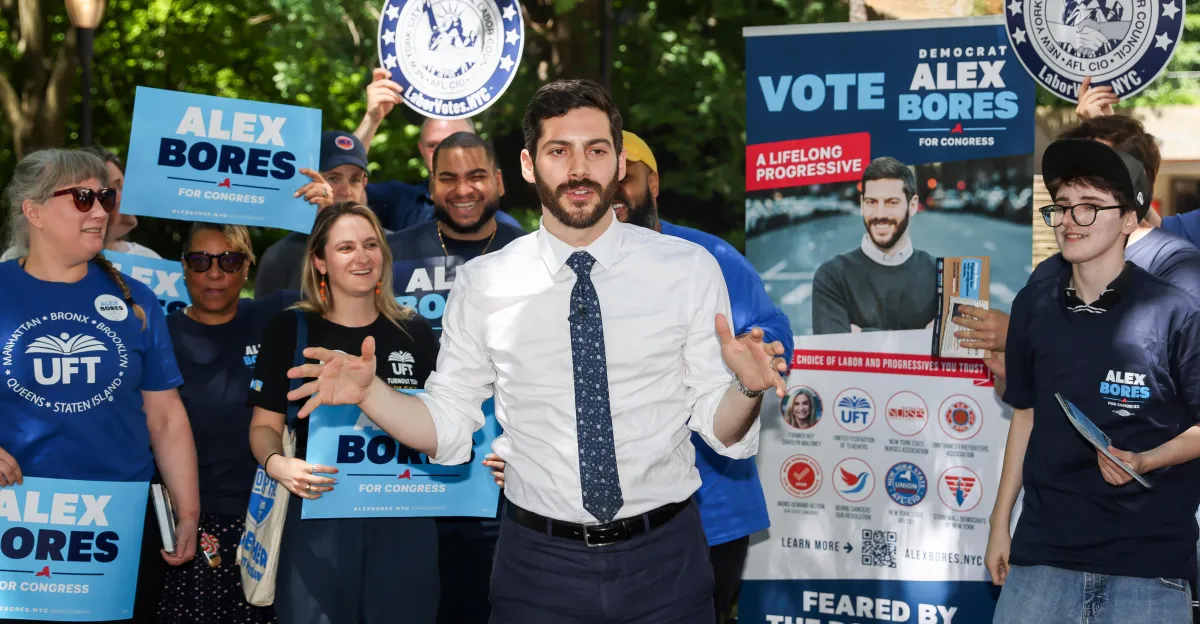
The immediate focus is on progressive New York state Assemblyman Alex Bores, who has become the central target of a multimillion-dollar super PAC struggle. Bores has framed his campaign around broader Democratic priorities, not around AI policy. But his sponsorship of one of the country’s first AI safety laws has made him a symbol in the tech world’s internal battle over regulation, and a magnet for well-funded intervention on both sides.
How a Manhattan primary became an AI spending war
The New York 12th District primary was expected to be a competitive Democratic race in one of the city’s safest blue seats. Instead, it has become a stage for an all-out spending contest by outside groups, including super PACs aligned with major names in the AI and crypto sectors.
The conflict intensified after AI-boosting political operation Leading the Future began airing attack ads aimed at Bores last year. That group has portrayed itself as a force for candidates who favor innovation and resist heavy-handed regulation. In response, multiple pro-Bores committees entered the race, each presenting the assemblyman as a defender of responsible AI policy and a necessary counterweight to industry lobbying.
What makes this contest unusual is the degree to which Bores himself appears to have been swept into a fight he did not set out to lead. His campaign has emphasized conventional issues, but the outside spending has turned AI safety into one of the race’s defining themes, whether the candidate wanted that label or not.
The main players in the super PAC fight
The spending ecosystem around NY-12 now includes several competing political vehicles, each with a different backer and strategic purpose. Some are openly tied to powerful industry figures. Others claim to represent grassroots concerns about the influence of wealthy tech donors.
Leading the Future and the anti-Bores offensive
Leading the Future, a super PAC devoted to supporting candidates favorable to the AI industry, has invested heavily against Bores. Its affiliated PAC, Think Big, has spent millions on advertising opposing him, making the race one of the clearest examples yet of the tech sector taking a direct interest in a House primary.
The group’s message has been consistent: Bores is too aligned with regulation and too much of a risk to the policy environment technology companies want in Washington. In a district where the primary winner is highly likely to coast in the general election, that kind of intervention matters because it can determine who reaches Congress in the first place.
Anthropic-linked pro-Bores committees
On the other side, two major pro-Bores committees have become closely associated with Anthropic, the AI company that has positioned itself as more focused on safety and responsible deployment than some of its rivals.
One of those groups, Dream NYC, drew attention after a large donation from a single Anthropic employee. Another, Jobs and Democracy, is funded through Public First Action, a nonprofit advocacy organization that received a $20 million contribution from Anthropic itself. Both have helped amplify Bores as a candidate who would defend sensible guardrails around AI development.
These committees did not simply show up as ideological allies. They became part of a broader industry schism, with one camp arguing that regulation is needed to reduce harm and another insisting that America should not slow down AI development with excessive restrictions.
Chris Larsen’s intervention
A third pro-Bores super PAC, You Can Push Back, was created by Ripple cofounder and crypto billionaire Chris Larsen. Its mission has been to support Bores and push back against what Larsen and allies see as the growing political power of OpenAI and other large AI players.
Reporting has suggested that coordinated pro-Bores digital activity on social platforms may have been connected to this network of support, though the group declined to discuss the matter publicly. The larger point, politically, is clear: this district has become the place where some of the wealthiest names in technology are trying to settle a larger debate about the future of AI policy.
What the money has changed
The scale of spending has turned a relatively localized Democratic primary into something resembling a national referendum on tech influence. Combined, the pro-Bores committees tied to large technology fortunes have reportedly spent $19.4 million, more than Bores’s own campaign expenditures and more than the sum spent by the main anti-Bores effort from Leading the Future alone.
The result is a race in which the candidate is almost overshadowed by the outside forces speaking on his behalf. That dynamic is especially striking because campaign finance rules prevent coordination between Bores’s team and the supportive super PACs. The official campaign and the outside groups may appear aligned, but legally they must remain separate.
The size of the spending also matters because it has the capacity to define a candidate before many voters have heard much from him directly. In a crowded media environment, paid advertising can create a simplified version of a race that may bear only a loose relationship to the issues voters care about most.
| Group | Role in the race | Approximate spending / funding | Alignment |
|---|---|---|---|
| Leading the Future / Think Big | Runs ads opposing Bores | Think Big has spent about $8.15 million against him | Pro-AI industry, anti-regulation |
| Dream NYC | Supports Bores | Backed by a large donation from an Anthropic employee | AI safety / pro-Bores |
| Jobs and Democracy | Supports Bores | Funded through Public First Action, which received $20 million from Anthropic | AI safety / pro-Bores |
| You Can Push Back | Supports Bores | Connected to Chris Larsen; spending details not fully public in the source | Counterweight to AI industry power |
| Guardrails Alliance | New anti-corporate-spending counterweight | Plans to spend $250,000 | Grassroots / labor-backed |
A backlash from the left and from labor
The race has not only drawn billionaire involvement. It has also sparked an effort to build a response from labor groups and ordinary tech workers who say they do not want the debate over AI dominated by a handful of ultra-wealthy donors.
That response came in the form of the Guardrails Alliance, a newly formed political vehicle intended to support Bores while explicitly pushing back against what its founders describe as corporate manipulation of elections. The group says it is not trying to outspend the larger super PACs with another billionaire-funded operation. Instead, it is trying to offer an alternative voice for unions and workers who want regulation without the influence of big money.
The group’s cofounder has argued that the purpose of the alliance is to create a political home for people worried that the anti-regulation wing of the AI sector is trying to distort elections, rather than to match the larger PACs dollar for dollar.
Its proposed spending, about $250,000, is modest compared with the millions flowing from the larger committees. But politically, its existence matters. It reflects growing discomfort among some progressive and labor-aligned voters who worry that even the “good” side of the AI policy fight can be distorted by the same moneyed logic it claims to oppose.
Why Bores became the center of the fight
Bores’s position in the debate is partly accidental and partly strategic. He helped pass one of the first AI safety laws in the country, which placed him in the camp most likely to attract support from companies and donors who want guardrails around the technology. That legislation gave him credibility in AI policy circles, even though his campaign has not been built around the issue.
At the same time, his policy record made him a natural target for the AI industry’s political counteroffensive. If the sector wanted to demonstrate that it could defend itself from tougher regulation, a race featuring a known AI safety advocate in a high-profile Manhattan district offered an ideal proving ground.
That combination turned Bores into an inadvertent symbol. He was not initially running as an AI candidate, but the spending wars around him have made him one anyway. The effect is familiar in modern politics: a local contender gets recast as a national test case once major outside money enters the picture.
The “AI safety” label he did not seek
Campaign insiders and observers have noted that Bores’s team has not tried to center the race around artificial intelligence. The campaign appears to have been focused on standard Democratic concerns. Yet the advertising environment has consistently pushed the AI policy angle back to the foreground.
That dynamic creates a paradox. If Bores wins, supporters may interpret the result as evidence that AI safety can still be a winning issue in a general-election minded district. If he loses, the defeat may be read less as a rejection of his ideology and more as proof that the outside spending battle crowded out everything else.
What voters actually care about
The most expensive political story in the race may not be the one voters are most focused on. Reporting from the district suggests that Manhattan Democrats are thinking about a broader and more familiar set of issues: affordability, the conflict in Israel and Gaza, resistance to Donald Trump, and the direction of the national Democratic Party.
That matters because NY-12 is not a single-issue district. Even in a race shaped by AI-money theatrics, local voters are still making decisions based on their daily economic realities and their views about national politics. The spending war may dominate political conversation, but it is far from the only force affecting the outcome.
Other contenders and outside forces
The race is also complicated by the presence of other well-connected candidates. Micah Lasher, another state Assembly member, has support from New York City political establishment figures and from a super PAC backed by Michael Bloomberg. Jack Schlossberg brings the Kennedy name and a social-media-friendly profile. George Conway, the longtime Republican lawyer turned anti-Trump personality, is also on the ballot.
That crowded field means Bores is not simply competing against AI-funded ads. He is competing against a variety of political brands, donor networks, and local loyalties. Any one of those factors could matter enough to change the outcome.
The polling picture remains murky
One reason the impact of the money is so hard to measure is that there has not been a fresh wave of reliable public polling since late May. A poll from Emerson College at that time showed Bores in a tight race with Lasher, but the campaign has since evolved, and outside spending has continued to change the environment.
Without updated surveys, it is difficult to know whether the ads have moved enough voters to matter. Political spending can produce visibility without persuasion, or it can subtly alter perceptions in ways that are hard to capture until election night. In this case, both the scale of spending and the volatility of the field leave plenty of uncertainty.
What is clear is that the race now functions as a laboratory for testing how much money can matter in a dense urban Democratic primary, especially when that money is attached to a new and highly technical issue like artificial intelligence.
Why the race matters beyond New York
Although the district is local, the implications are national. AI policy is emerging as one of the most contested political issues in Washington, and this primary offers one of the clearest examples yet of how the industry plans to fight over it.
If major companies and their allies can effectively shape a congressional primary in Manhattan, they may conclude that similar tactics can work in other races where one candidate or another can be tied to a broader regulatory agenda. If they cannot, the industry may need to rethink how much political capital it can buy with outside expenditures.
There is also a symbolic dimension. AI firms want to be seen not just as technology leaders but as legitimate political actors capable of defending their interests. Their opponents want to show that democracy should not be run through donor-funded super PACs. NY-12 has become the place where those narratives meet.
What a Bores win would signal
A victory for Bores would likely be interpreted in two ways at once. First, it would suggest that AI safety can be a viable issue even in a district with varied Democratic constituencies. Second, it would reinforce the idea that the tech industry’s preferred candidates are not guaranteed to win simply because they can outspend rivals.
It would also embolden the view that resistance to unchecked AI growth has political value — not just moral appeal.
What a Bores loss would mean
If Bores falls short, it may not be because his views on artificial intelligence were rejected outright. It may instead mean that the race became too crowded, too expensive and too defined by outside narratives to give his campaign room to breathe.
In that sense, the result would still be instructive. It would show how elite conflict over AI can distort a local democratic contest, even when the candidate at the center of that conflict was not trying to make the technology the centerpiece of his run.
The broader problem of corporate political power
Beyond the specifics of NY-12, the race raises a deeper question about how corporate money operates in contemporary elections. The issue is not only whether one side is spending more than the other. It is whether super PACs tied to powerful firms can redefine a candidate’s identity, create artificial issue salience and force voters to process local politics through the lens of industry battles.
That concern is especially acute in the AI sector, where policymaking is still developing and the stakes are framed in sweeping terms: innovation, competitiveness, job loss, safety, democracy and national power. As a result, a House primary can become a stand-in for much bigger arguments about the future of the technology.
For now, the Manhattan race is a vivid demonstration of how quickly a local campaign can be nationalized when a new industry sees political opportunity. It is also a reminder that even in a city as politically sophisticated as New York, big money still buys attention — and sometimes, enough influence to change the story of an election before voters have even cast their ballots.
What to watch next
When the votes are counted, observers will look past the final margin and focus on the meaning of the result. Did AI spending help define the winner? Did outside money backfire by making the race look manipulated? Or did voters simply tune out the super PACs and vote on familiar issues?
Those questions will matter well beyond one district. The answer will offer an early look at whether AI companies can translate their financial power into electoral power — and whether a grassroots response can stop them.
- The race is a major test of how far AI-sector money can shape a local primary.
- Alex Bores has become the focal point of rival super PACs despite not running on AI as a core campaign theme.
- Pro-Bores and anti-Bores outside groups have spent far more than the campaign itself.
- A new labor-backed committee is trying to counter billionaire influence with a smaller grassroots effort.
- The outcome may shape how tech companies and regulators view future congressional races.
| Milestone | What happened | Why it matters |
|---|---|---|
| Last year | Leading the Future begins airing anti-Bores advertising | Launches the AI industry’s direct intervention |
| Afterward | Anthropic-linked groups and a Chris Larsen-backed PAC move to support Bores | Turns the race into an internal tech-world conflict |
| May 21 | Emerson College releases the last major public poll referenced in the race | Shows Bores in a tight contest with Lasher |
| Last week | Guardrails Alliance announces $250,000 in planned pro-Bores spending | Creates a labor-backed response to billionaire-funded influence |
| Primary day | NY-12 voters decide the Democratic nominee | May determine the next member of Congress and the narrative around AI politics |
In the end, the NY-12 primary is about much more than one seat in Manhattan. It is about whether corporate AI money has found a new model for political influence — and whether voters will let that model work.