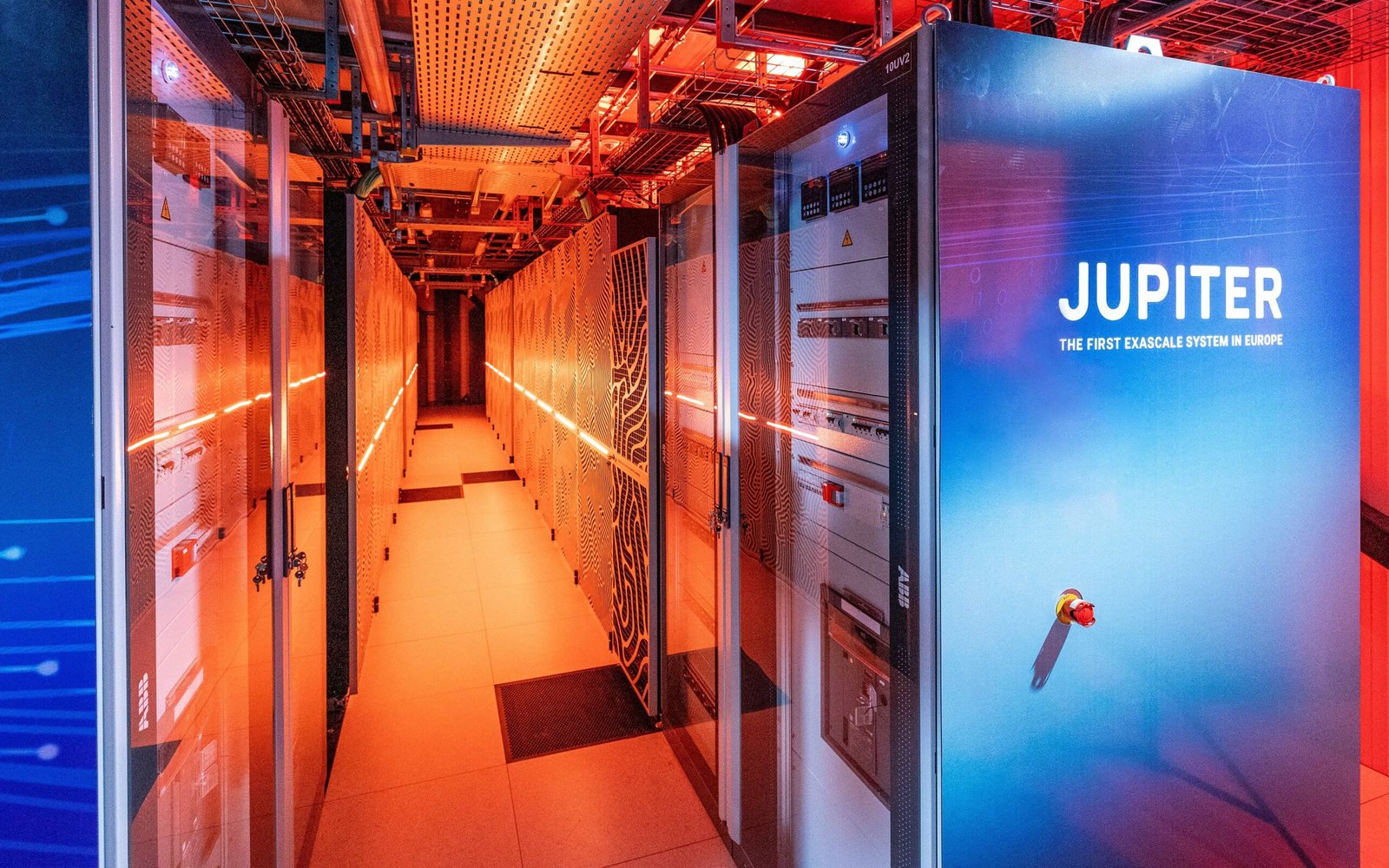
In a bold assertion of technological ambition and sovereignty, Europe has officially entered the exascale era with the inauguration of JUPITER, its most powerful supercomputer to date. Deployed at the Forschungszentrum Jülich in Germany, the Jupiter system—short for Joint Undertaking Pioneer for Innovative and Transformative Exascale Research—promises to reshape the continent’s standing in AI, quantum research, climate modeling, and beyond.
Launched on September 5, 2025, by German Chancellor Friedrich Merz, Jupiter is not only a technical marvel but a political statement—declaring Europe’s resolve to bridge the digital and AI capability gap with U.S. and China.
Reclaiming Tech Sovereignty: A Strategic Imperative
Standing alongside leading executives from NVIDIA, Atos/Eviden, and ParTec, Chancellor Merz emphasized the geopolitical implications of the system:
“We in Germany and in Europe have every opportunity to catch up and then to hold our own.”
Jupiter is a €500 million investment co-funded by the European Union, Germany’s Federal Ministry of Education and Research, and the state of North Rhine-Westphalia. The supercomputer is part of the EuroHPC JU initiative, which is tasked with building a network of European high-performance computing (HPC) infrastructures to ensure digital sovereignty and scientific independence.
The Architecture Behind Exascale: Modular Brilliance
At its core, Jupiter is designed with a modular hybrid architecture, separating the system into two primary modules:
- Booster Module: Houses approximately 24,000 NVIDIA GH200 Grace Hopper Superchips, optimized for ultra-high performance in AI and simulation tasks. This module delivers raw exascale compute power—over 1 quintillion (10¹⁸) calculations per second.
- Cluster Module: Powered by Rhea ARM-based CPUs, this component excels at data-heavy tasks, such as large-scale simulations and memory-bound workflows.
The combined architecture allows for scalable, heterogeneous workloads, making Jupiter a truly flexible research engine.
What truly distinguishes Jupiter, however, is its AI optimization: it achieves up to 90 exaflops in AI-specific operations using 8-bit precision—making it a leader not only in traditional HPC but also in training and deploying large language models (LLMs).
Energy Efficiency & Sustainability: Setting a Global Standard
Jupiter doesn’t just break speed records—it does so responsibly. The system is hailed as the most energy-efficient supercomputer module in the world, topping the Green500 list. Key energy innovations include:
- 100% Renewable Energy Usage
- Advanced Water-Cooling Systems
- Heat-Recycling that repurposes waste heat to power adjacent buildings
This commitment to green compute infrastructure aligns with Europe’s climate goals and sets a new standard for sustainable AI research.
Scientific Breakthroughs on the Horizon
Jupiter is expected to catalyze scientific breakthroughs across an astonishing range of fields:
1. Climate and Weather Modeling
Jupiter enables next-generation Earth system modeling, potentially unlocking decade-scale weather forecasts and real-time disaster prediction. High-resolution climate simulations will help Europe lead in green transition planning and disaster resilience.
2. Drug Discovery & Neuroscience
With its massive parallel compute capacity, researchers can simulate protein folding, molecular interactions, and even whole-brain neural activity—accelerating therapeutic discoveries and brain research at an unprecedented scale.
3. Quantum Computing Simulation
Jupiter will simulate qubit-level quantum systems, helping researchers push the envelope in quantum theory and materials science before practical quantum computers are viable.
4. AI & LLM Infrastructure
Jupiter will act as a continental-scale training ground for Europe’s LLMs, backing initiatives like the European AI Factory and national efforts to build alternatives to GPT, Claude, and Gemini.
5. Engineering Simulations & Digital Twins
From simulating airflow in turbine blades to modeling traffic systems and energy grids, Jupiter will advance smart infrastructure and digital twin technology, supporting industries from manufacturing to transport.
Democratized Access & Research Collaboration
Access to Jupiter will be made available via:
- JUREAP (JUPITER Research and Early Access Program)
- The Gauss Centre for Supercomputing
- EuroHPC JU’s allocation programs
Researchers, enterprises, startups, and universities across the EU can apply for compute time, fostering pan-European collaboration in both public and private sectors.
A Challenge to U.S. and Chinese Dominance in HPC
Jupiter’s performance now places it fourth on the global TOP500 list of the fastest supercomputers, trailing behind systems from the U.S. and China. While the Frontier supercomputer in the U.S. still holds the exascale crown, Jupiter’s launch signals that Europe is no longer content with being a bystander.
Its capabilities are on par with NVIDIA’s own U.S.-based installations and far surpass any previous European HPC system, including the LUMI system in Finland.
The Road Ahead: Building Europe’s Digital Future
Jupiter represents more than a milestone in supercomputing—it is a symbol of Europe’s digital ambition. It proves that with coordinated funding, technological partnerships, and political will, the continent can lead in the global AI and research ecosystem.
The system will also serve as a foundation for regulatory, ethical, and open-access models in AI development, ensuring Europe maintains its edge not just technologically, but philosophically.
Technical Summary at a Glance
| Component | Details |
|---|---|
| Peak Compute | ≥1 exaflop (10¹⁸ FLOPS) |
| AI Performance | Up to 90 exaflops (8-bit precision) |
| Architecture | Modular (Booster + Cluster) |
| Main Chips | NVIDIA GH200 Superchips + Rhea ARM CPUs |
| Energy Source | 100% renewable |
| Cooling | Water-based with heat recycling |
| Location | Forschungszentrum Jülich, Germany |
| Cost | €500 million (EU + German federal + NRW state) |
| Global TOP500 Rank | 4th (as of June 2025 |