In short
G2 Venture Partners says AI data centers could be built faster and cheaper with off-grid solar plus long-duration storage than with gas-heavy power plans. The firm argues the model could bypass grid-access and permitting bottlenecks as AI electricity demand surges.
- G2VP says off-grid solar plus storage could speed up AI data-center buildouts.
- The firm estimates more than $4 trillion in data-center investment through 2029.
- Brook Porter argues grid access and air-permit constraints make renewable campuses attractive.
- Long-duration storage startups like Form Energy and Antora are helping lower the cost barrier.
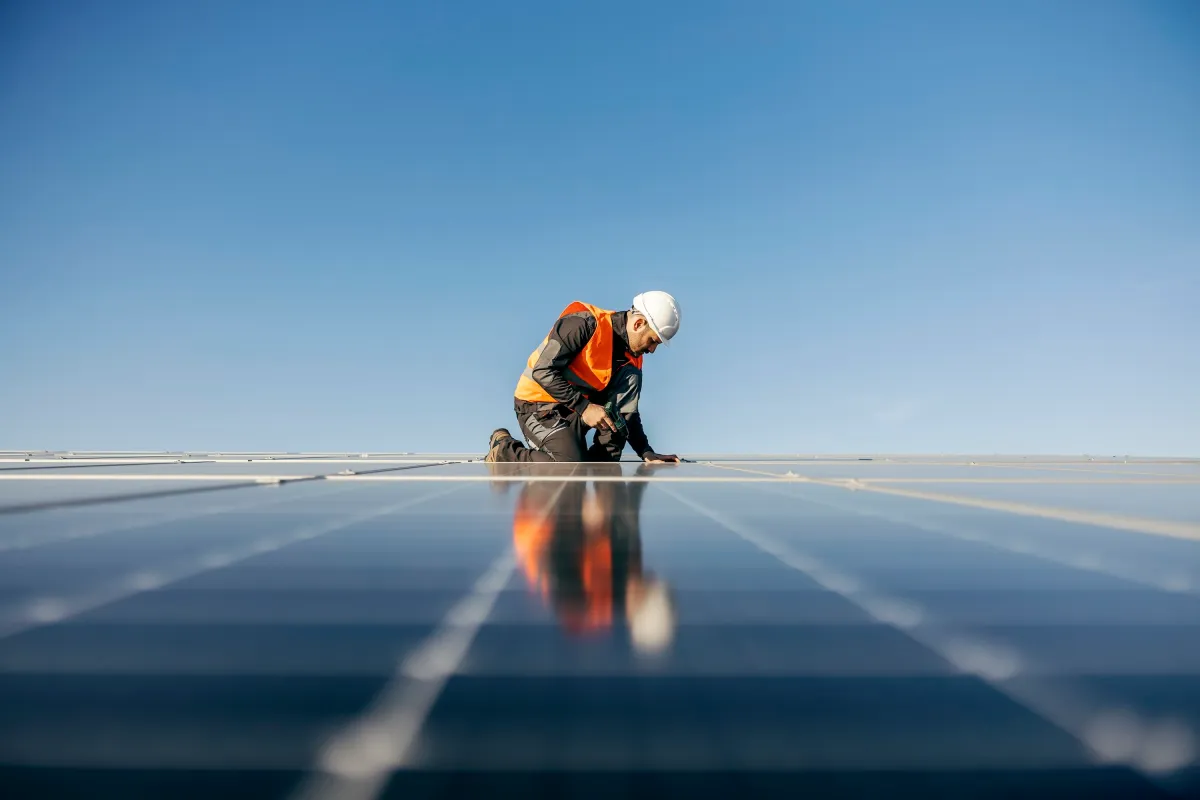
G2 Venture Partners is arguing that the fastest way to power the AI buildout may not be natural gas at all, but off-grid solar paired with long-duration batteries. The firm says the approach could let large data centers come online sooner, dodge grid bottlenecks and cut through air-permit delays that are slowing conventional projects.
The pitch lands at a moment when AI infrastructure is colliding with the physical limits of electricity supply. TechCrunch reported that G2VP sees data-center investment topping $4 trillion through the end of 2029, a scale that helps explain why power access has become one of the central debates of the AI era.
Why it matters
This is not just an energy story. It is a question about where AI systems get built, how quickly they can scale and which power sources will dominate the next generation of data-center infrastructure.
For operators, the attraction of an off-grid renewable site is straightforward: if the local utility cannot deliver enough power fast enough, the project can still move ahead using its own generation and storage. G2VP partner Brook Porter said that approach could shorten development timelines dramatically, an advantage when every month matters in a race to secure chips, land and electricity.
For communities and regulators, the implications are equally significant. If developers increasingly bypass congested grids, the geography of data-center investment could shift toward places with strong solar resources, available land and workable transmission alternatives. That could reduce pressure on some power systems, but it could also concentrate industrial buildouts in new regions.
And for the energy market, the investment logic is powerful. Solar and long-duration storage are modular, scalable and, in G2VP’s view, increasingly aligned with the economics of Wright’s Law, which holds that costs tend to fall as deployment rises. If that view proves right, AI infrastructure could become an unexpectedly strong driver of renewable buildout.
What G2 Venture Partners is saying
G2VP is pitching what it describes as two broad paths for new data centers. Smaller facilities may remain tied to the grid and rely on some on-site generation. Larger projects, by contrast, could be built off-grid around renewable power and long-duration storage.
Porter’s argument is that the second model may be faster in practice because it avoids two of the biggest hurdles facing new power-hungry facilities: grid-access delays and air-permit constraints. Natural gas has often been the fallback because it can be deployed quickly enough to bridge near-term demand. But G2VP says the combination of solar generation and storage could offer a different route, especially for enormous AI campuses that need reliable electricity around the clock.
“The big idea is to go off-grid,”
Porter also framed the underlying demand problem in blunt terms:
“Demand is growing faster than people appreciate”
That view matters because AI data centers are not just large users of electricity; they are industrial-scale loads requiring power for chips, cooling and networking. The pressure has already pushed some hyperscalers and developers to use whatever supply they can secure, including natural-gas plants. G2VP’s thesis is that a different answer is becoming viable sooner than many in the market assume.
How could solar plus storage compete with gas?
It could compete by matching the practical needs of developers rather than the traditional assumptions of the grid. Solar is intermittent, but long-duration storage can shift electricity from daylight hours into the evening and overnight. That makes the package more useful for a load that must run continuously.
G2VP says the economics also favor scale. Solar and long-duration batteries can be expanded in modules, which means developers can add capacity in stages instead of waiting for a single massive power connection. The firm argues that this fits Wright’s Law economics, where manufacturing and deployment at scale tend to drive down costs over time.
Porter pointed to the relative scale of available resources as well. He said natural-gas annual capacity runs at roughly 60 to 70 gigawatts globally, while solar is already installed at well over a terawatt. That gap, in G2VP’s telling, shows that solar has a much larger industrial base behind it.
By the numbers
| Metric | Figure | What it refers to |
|---|---|---|
| U.S. grid growth | Several gigawatts a year | Recent annual growth in the U.S. grid, according to the fact sheet |
| Natural-gas capacity | 60–70 gigawatts per year | Global annual capacity cited by Brook Porter |
| Solar capacity | Well over a terawatt | Global installed solar scale cited by Brook Porter |
| Data-center investment | $4 trillion | G2VP estimate through the end of 2029 |
Background: how the power crunch became central to AI
The electricity challenge is a direct consequence of the AI infrastructure race. Modern AI systems need vast amounts of energy not only to run the chips themselves, but to cool them and keep the surrounding networking equipment operating reliably. That has turned power procurement into a strategic problem for developers and hyperscalers.
In recent years, builders have often turned to whatever could be secured fastest. Natural gas became a common interim answer because it could be brought online more quickly than some grid upgrades. But that approach comes with its own limitations, including air-permit issues and the broader challenge of building enough fossil-fuel capacity fast enough to satisfy a surging market.
G2VP says it had a close view of how this market evolved through its involvement in Crusoe’s Series C. That gives the firm a front-row seat on a sector where data-center design, power sourcing and siting decisions are increasingly intertwined.
The firm’s latest argument, as reported by TechCrunch, is that the next wave of AI buildouts may not need to wait for the grid to catch up. Instead, developers could use distributed energy assets to create self-contained industrial power systems, especially in areas with strong solar potential.
Why off-grid projects could be faster
Off-grid development matters because speed is now a competitive advantage. If a developer can secure land, build generation and install storage without waiting for a utility interconnection queue, the project may reach operation sooner than a traditional grid-tied campus.
That is the core of Porter’s argument: a renewable-plus-storage project can bypass two chokepoints at once. The first is access to grid power, which can take years to secure in crowded markets. The second is permitting tied to gas generation, which can complicate or slow fossil-based projects.
It is not a claim that solar and batteries are already universal replacements for gas. G2VP is careful to suggest the technologies may still be years from broad adoption. But the firm says developers should start planning for the model now because the economics and the urgency of the AI buildout are moving quickly.
Who might adopt this model first?
Large data-center developers and hyperscalers are the most likely early adopters, but the fact sheet does not name any specific company moving in that direction. G2VP’s thesis is aimed at the broader market of firms trying to bring new AI infrastructure online faster than the grid can accommodate.
The names already in the story point to the likely ecosystem: Crusoe as a data-center developer, and Form Energy and Antora Energy as long-duration storage startups that G2VP says have lowered costs enough to attract attention from planners.
What the market numbers suggest
The scale of the opportunity is what makes the thesis hard to ignore. G2VP estimates that data-center investment will exceed $4 trillion through the end of 2029. Even if that figure proves high, the direction is clear: the amount of capital flowing into AI infrastructure is large enough to influence power markets, land use and industrial siting decisions.
That spending will not all go into the same kind of project. G2VP’s view is that the market will split between smaller grid-tied sites and larger off-grid renewable campuses. Those are different capital structures, but both reflect the same underlying pressure: AI workloads need electricity now, not eventually.
- Smaller sites may keep leaning on the grid and on-site generation.
- Larger campuses may increasingly seek off-grid renewable power.
- Long-duration storage is the bridge that makes solar relevant for 24/7 demand.
- Permitting and interconnection remain central constraints on fast buildouts.
What happens next
The near-term question is not whether AI data centers need more power. They do. The open questions are which power stack wins, how quickly storage costs fall and whether developers truly find off-grid projects easier to execute than gas-heavy alternatives.
Watch for three things. First, whether specific hyperscalers or large developers publicly commit to solar-plus-storage campuses. Second, whether long-duration storage companies such as Form Energy and Antora can keep driving costs down enough to make the model commercially routine. Third, whether permitting and grid constraints continue to make self-contained power systems attractive compared with traditional utility hookups.
There is also the larger test of G2VP’s forecast itself. If the firm is right, data-center investment will surge to more than $4 trillion by the end of 2029, and the shape of that spending could tilt the AI industry toward renewable buildouts faster than many expect. If it is wrong, gas may remain the default bridge for longer than renewable advocates would like.
Either way, the central debate is already clear: AI is no longer only a software story. It is becoming a contest over watts, land, permits and the speed at which industrial power can be built.
Context: why this debate is broader than one sector
TechCrunch’s reporting on G2VP frames power supply as one of the defining issues of the AI age. That is because the choice of energy source shapes nearly every other decision in the buildout cycle: where a facility can be located, how fast it can be approved, what kind of cooling systems it needs and how resilient it will be under peak demand.
For investors, that means the data-center boom is not just a bet on chips or cloud demand. It is also a bet on infrastructure that can be financed, permitted and built at the same pace as AI adoption. G2VP is signaling that solar plus long-duration storage may be one of the few options that can scale with that demand without running headlong into the limits of the existing grid.
For readers, the practical takeaway is simpler. The next wave of AI infrastructure may not be powered the way many expect, and the companies that solve electricity first may shape where the industry grows next.
Bottom line: G2 Venture Partners is making a case that solar and long-duration batteries could power future AI data centers faster and cheaper than gas-heavy approaches, a bet that could influence where the industry builds and how the next wave of power demand is met.
Frequently asked questions
Why is G2 Venture Partners backing solar and batteries for AI data centers?
G2 Venture Partners says solar plus long-duration storage could let AI data centers come online faster than gas-heavy projects. The firm argues that off-grid renewable campuses can avoid grid-access delays and some air-permit hurdles while still meeting the huge electricity needs of AI infrastructure.
How much data-center investment does G2VP expect by 2029?
G2VP expects data-center investment to exceed $4 trillion through the end of 2029. That estimate underscores how large the AI infrastructure buildout has become and why power sourcing is now a central strategic issue for developers and investors.
What is long-duration storage, and why does it matter here?
Long-duration storage refers to batteries or other systems that can shift power for many hours instead of only minutes. It matters because solar is intermittent, and AI data centers need round-the-clock electricity for chips, cooling and networking.
Why does G2VP think off-grid projects could move faster?
G2VP says off-grid projects can bypass two major bottlenecks: slow grid access and air-permit constraints tied to gas generation. That could shorten the time it takes to bring a large data center online, which is crucial in a fast-moving AI market.
Which companies are mentioned as part of the storage ecosystem?
The fact sheet names Form Energy and Antora Energy as long-duration storage startups that have reduced costs enough to interest data-center planners. G2VP says those cost improvements are helping make solar-plus-storage a more realistic option for large AI facilities.