Updated November 10, 2026 3:23 am
In short
Trump says he was aware of the Jensen Huang controversy only vaguely and not too recently, while new reporting says Huang has admitted infidelity, Nvidia has launched an internal probe and Marco Rubio helped draft an intelligence memo before Trump’s China trip.
- Trump said he only recently learned about the alleged spy controversy involving Jensen Huang.
- AP and oregonlive said Nvidia shares fell about 5% in premarket trading Monday.
- Trump is due to meet Xi Jinping next week in Shenzhen at the APEC summit.
- China denied the allegation and called it a smear campaign.
- Key details about the FBI inquiry and the evidence behind the claim remain unclear.
Update — November 10, 2026 3:23 am
Trump now says he has been hearing and reading about the Jensen Huang matter “over a period of time,” but still cannot pin down exactly when he was first briefed. He also suggested it may have been mentioned in passing, while saying it did not make much of an impression on him.
The Verge’s updated account also says Huang has acknowledged being “unfaithful,” and that Nvidia has opened its own investigation into the matter. Trump said he spoke with Huang on Monday and believes the Nvidia chief is suffering because of the impact on his family.
The new reporting further notes that Secretary of State Marco Rubio helped draft an intelligence memo about the relationship before Trump’s May trip to China, adding another layer to the timeline around what the administration knew and when.
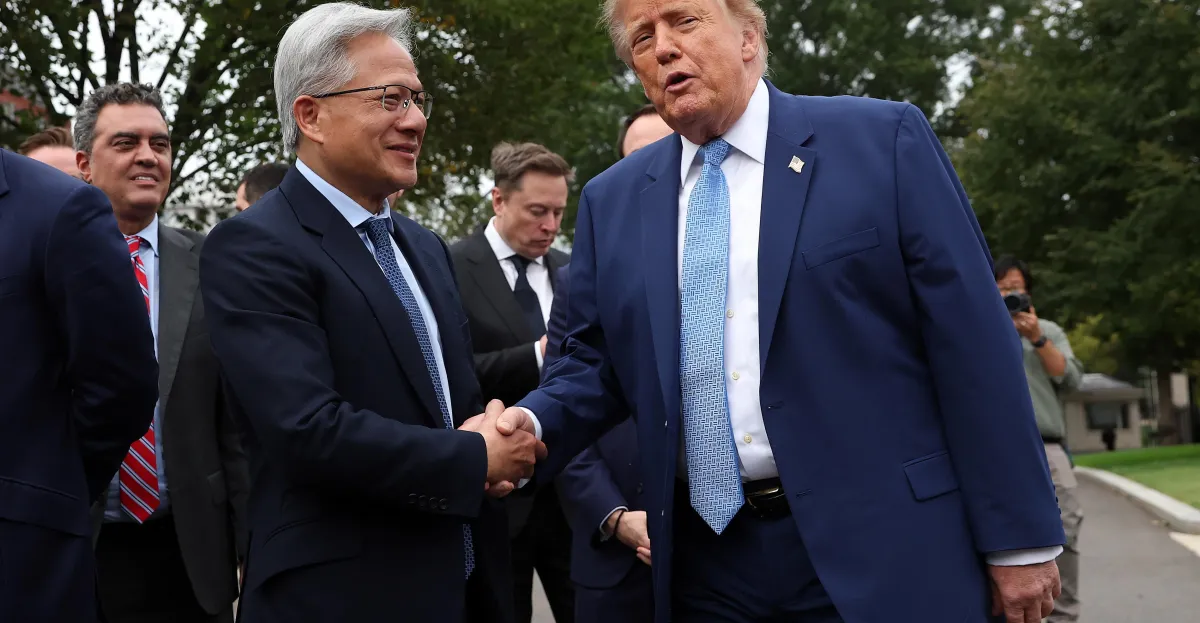
President Donald Trump said Monday he had only recently learned about the alleged spy-related controversy around Nvidia chief executive Jensen Huang, and suggested Huang himself had no idea the woman at the center of the claim was a spy. The comments put a personal scandal, U.S.-China technology tensions and a high-stakes White House-China diplomacy calendar into the same frame just as Trump is due to meet Xi Jinping next week.
The episode matters because Nvidia sits at the center of the artificial intelligence boom, U.S. chip exports to China remain politically sensitive, and the White House is balancing counterintelligence concerns with a company that has become one of America’s most important technology exporters. According to The Verge, Trump said he had learned about the issue only “not too long ago,” while AP and oregonlive reported that he also tried to reassure Huang that he had nothing to worry about from an FBI inquiry.
What Trump said about the Huang controversy
Trump’s public comments were striking for their tone as much as their content. Rather than distance himself from Huang, he defended the Nvidia leader as a long-time acquaintance and described him as an honorable businessman who built a major American company.
In remarks reported by The Verge, Trump said Huang told him he had “no idea” the woman was a spy. Trump also said he had been reading about the matter over time and would check on the intelligence side, but he would not pin down exactly when he first heard about it.
The president said he did not hear about the alleged spy ties during his May trip to China. He also suggested the issue would probably not come up in his planned meeting with Xi next week, a sign that he sees the matter as separate from the broader U.S.-China agenda, at least for now.
“He said he had absolutely no idea that the person in question was a spy.”
That quote, attributed to Trump by The Verge, captures the line he is taking: Huang may be in the middle of a politically explosive story, but the president is publicly treating him as a trusted figure rather than a suspect.
How did Trump describe the FBI inquiry?
Trump said the FBI is looking into “something else” involving Huang, but did not explain what that means or what, if anything, investigators have found. AP and oregonlive reported that Trump told Huang not to worry about the bureau’s inquiry and predicted that he would be “in good shape.”
That formulation matters. It signals that the administration is aware of an active law-enforcement or intelligence-adjacent matter, but the president is not framing it as a confirmed wrongdoing by Huang. Instead, he appears to be separating the FBI’s interest from the broader allegation about a possible Chinese spy connection.
Trump also described Huang in personal terms. According to AP and oregonlive, he said, “I just know Jensen very well. I just think he’s a very honorable man.” The line reinforces the unusual nature of the president’s response: at a moment when Washington often speaks cautiously about China-linked technology concerns, Trump is publicly vouching for one of the industry’s most powerful executives.
Why it matters
This is more than a celebrity-tech scandal. It sits at the intersection of national security, semiconductor policy and the politics of U.S.-China competition.
Nvidia is not just another public company. It is a leading chipmaker central to AI computing, and its products sit at the heart of the race to train and deploy advanced artificial intelligence systems. That makes any allegation involving possible foreign influence, private relationships or intelligence questions more consequential than an ordinary corporate dispute.
The reporting also lands in the middle of a sensitive trade and security backdrop. U.S.-China chip sales are a recurring national-security issue, and Nvidia has only been able to sell a small amount of chips to China because sales are restricted by Beijing, according to AP and oregonlive. That means both sides already approach the company through the lens of strategic competition rather than simple commerce.
For readers, the immediate implication is uncertainty. If the FBI is exploring “something else,” as Trump put it, there is no public clarity yet on whether that involves a security risk, a personal matter, a compliance issue or something else entirely. For investors, that uncertainty can be enough to move the stock. AP and oregonlive said Nvidia shares fell about 5% in premarket trading Monday.
For the White House, the issue carries a diplomatic risk too. Trump is due to meet Xi Jinping next week in Shenzhen at the APEC summit, according to AP and oregonlive. Any question tied to Chinese espionage claims, or to the political treatment of a major U.S. chipmaker, can become part of the broader atmosphere around that meeting even if it is not formally on the agenda.
What happened to Nvidia’s stock?
Nvidia shares fell about 5% in premarket trading Monday, AP and oregonlive reported, underscoring how quickly a story with legal, geopolitical and personal dimensions can hit markets.
That decline came before the full trading day opened, which means investors were reacting to the headlines and the uncertainty they created rather than to any confirmed regulatory action. The fact that the company’s stock moved so sharply illustrates how sensitive Nvidia has become to anything that touches its leadership or its China business.
| Item | What the reporting says | Why it matters |
|---|---|---|
| Nvidia shares | Fell roughly 5% in premarket trading Monday | Shows investor sensitivity to leadership and China-related uncertainty |
| Trump-Xi meeting | Scheduled for next week in Shenzhen at APEC | Creates a diplomatic backdrop for the controversy |
| Huang family donation | $50 million in 2022 to Oregon State University | Shows Huang’s long-standing public profile beyond Silicon Valley |
| China chip sales | Only a small amount of Nvidia chips sold there because sales are restricted | Highlights the policy limits around the company’s business in China |
Background: how the story built up
The story did not begin with Monday’s White House remarks. The Verge reported that a New York Times account said Trump had been informed roughly a year ago about Huang’s close relationship with Alice Huang, a Chinese citizen and former Megaspeed executive. That detail matters because it suggests the current controversy has been circulating in some form for a while before it reached the Oval Office briefing room.
Trump said he did not hear about the matter during his May trip to China, which points to a gap between whatever intelligence or political discussions were happening inside Washington and the public line he took while traveling. He also said he had learned of the matter only recently and could not recall the exact timing.
Another important piece of context is the role of White House intelligence briefings. Officials can receive information about counterintelligence concerns through those channels, and the fact sheet points to a reported memo or briefing discussion involving Marco Rubio, though it is not clear whether Trump had seen it or when. That uncertainty is itself part of the story: the public can see the controversy, but not the full chain of internal government awareness behind it.
The background also includes Huang’s own response. AP and oregonlive said Huang apologized to his wife and Nvidia in an open letter on the company’s website. His employee statement, according to those reports, said he was taking full responsibility and trying to regain trust. That language suggests the controversy has a personal dimension beyond geopolitics, and it may be connected to the alleged spy allegation only indirectly.
How did China respond?
China denied the spy allegation and called it a smear campaign, according to AP and oregonlive. Guo Jiakun, a Chinese Foreign Ministry spokesperson, said, “The so-called Chinese spy allegation is unsubstantiated. It is nothing but smears against China.”
That response is consistent with Beijing’s tendency to reject public accusations that touch on espionage or foreign influence. It also shows how quickly a private scandal can be recast as a broader political fight when it involves Chinese nationals, major U.S. companies and national-security concerns.
What do the outlets agree on — and where do they differ?
The Verge and AP/oregonlive converge on the same basic picture: Trump is publicly minimizing the significance of the matter, saying Huang did not know the woman was a spy, and suggesting the FBI inquiry is separate from the specific allegation making headlines.
But the reporting differs in emphasis. The Verge focused more on Trump’s claim that he had only recently heard about the affair and on his uncertainty about when he learned the details. AP and oregonlive placed more weight on Trump’s conversation with Huang, his reassurance that the Nvidia chief would be in “good shape,” and the market reaction that followed.
That split is useful for readers because it clarifies the two tracks of the story. One track is political and investigative: who knew what, and when, about the alleged spy connection. The other is market and diplomatic: how the allegation affects Nvidia’s stock, and whether it shadows the president’s upcoming meeting with Xi.
Timeline of the controversy
The reporting points to a short but layered sequence of events. A timeline helps separate the factual anchors from the speculation around them.
| Date / period | Reported development |
|---|---|
| Roughly a year ago | The New York Times reportedly said Trump was briefed on Huang’s close relationship with the alleged spy |
| May | Trump said he traveled to China without hearing about the alleged ties then |
| Sunday, Nov. 8, 2026 | Huang issued a statement acknowledging infidelity and saying he was working to regain trust |
| Monday, Nov. 9, 2026 | Trump addressed the matter at a White House briefing |
| Next week | Trump is expected to meet Xi Jinping in Shenzhen at APEC |
Why the Nvidia-China connection keeps resurfacing
Nvidia’s importance in AI explains why it keeps showing up in policy debates. The company’s chips are essential to training large models and powering the infrastructure that supports them. That gives the company enormous commercial leverage, but it also places it under constant scrutiny from Washington because advanced chips can have national-security implications.
That tension is especially sharp with China. The fact sheet says Nvidia sold only a small amount of chips to China because sales are restricted by Beijing, an awkward reminder that the company is operating in a space shaped by both American export controls and Chinese market access limits. Even without the current allegation, Nvidia’s China exposure would already be a sensitive subject for policymakers.
The controversy involving Huang adds a human layer to an already sensitive corporate story. When the chief executive of a company this central to AI becomes part of a personal and possible intelligence-linked dispute, the result is more than a private embarrassment. It raises questions about trust, access, perception and governance at a moment when all four matter enormously.
What happens next
The immediate next milestone is Trump’s planned meeting with Xi in Shenzhen next week at the APEC summit. Trump said the matter would probably not come up, but given the public attention around the alleged spy link and Nvidia’s place in the U.S.-China tech relationship, it will be worth watching whether the subject surfaces indirectly.
The other question is the FBI inquiry. Trump did not specify what the bureau is investigating, and no public details have been provided about the scope or status of that work. If the investigation is real and active, more clarity may eventually come from official documents, court filings or additional reporting. If not, the lack of specifics will continue to fuel speculation.
There is also the corporate angle. Huang’s open letter and employee statement suggest Nvidia is trying to manage the fallout internally. Whether that effort is enough will depend on what, if anything, the company discloses next and whether the controversy affects relationships with partners, regulators or investors.
Finally, there is the evidence question. The fact sheet is clear that the alleged spy link has been reported, denied by China, and publicly discussed by Trump, but it also makes clear that key details remain unresolved. What evidence supports the claim, what exactly the FBI is investigating, and whether any confidential information was compromised are all still open.
Bottom line
Trump’s remarks turn a potentially narrow personal and security controversy into a broader story about the politics of AI, the fragility of U.S.-China tech ties and the market power of a company that has become indispensable to the current computing cycle. For now, the president is signaling confidence in Huang. The larger questions, however, are still hanging in the air.
Frequently asked questions
What did Trump say about the Nvidia spy allegation?
Trump said he had only recently learned about the matter and that Huang told him he had no idea the woman was a spy. He also said the issue would probably not come up in his meeting with Xi Jinping next week.
Why does this matter for Nvidia?
It matters because Nvidia is a central AI chipmaker with major exposure to U.S.-China tensions. Any allegation involving its chief executive can affect investor confidence, raise national-security questions and complicate the company’s already sensitive China business.
Is the FBI investigating Jensen Huang?
Trump said the FBI is looking into “something else” involving Huang, but he did not explain what that means. No public details in the fact sheet clarify the scope of the inquiry, so the exact target of any investigation remains unclear.
How did China respond to the allegation?
China denied the allegation and rejected it as a smear campaign. Foreign Ministry spokesperson Guo Jiakun said the “so-called Chinese spy allegation is unsubstantiated,” according to AP and oregonlive.
Did Nvidia stock move because of the story?
Yes. AP and oregonlive reported that Nvidia shares fell about 5% in premarket trading Monday, indicating that investors reacted quickly to the uncertainty surrounding the allegation and the broader controversy.