In short
Arizona’s hyperscale data center boom is running into bipartisan resistance as water scarcity, utility pressure and land-use concerns overshadow promised jobs and tax revenue. The backlash is especially sharp in Tucson, where Project Blue has become a flash point.
- Arizona residents are increasingly opposing hyperscale data centers over water, power and land use.
- TSMC’s Phoenix chip complex was welcomed, but new projects are drawing far more resistance.
- Project Blue in Tucson is planned as a 600-megawatt, 290-acre build and has become a symbol of the fight.
- Reuters reporting cited by AOL.com says water is now central in Arizona politics and campaign messaging.
Arizona’s latest wave of hyperscale data center plans is running into fierce resistance because residents now see them as a threat to water, power and land use. The backlash stands in sharp contrast to the warm reception given to TSMC’s Phoenix chip complex, which was sold as an economic trophy rather than a burden.
What changed in Arizona’s tech boom?
Arizona is still trying to turn itself into a major semiconductor and digital infrastructure hub. But according to The Verge and AOL.com’s reporting based on Reuters, the political mood has shifted: projects that once might have been greeted as signs of growth are now being scrutinized for what they will take from a drought-stressed state.
That shift matters because Arizona has spent years marketing itself as a place where advanced manufacturing and related industries could expand. The problem is that the same qualities that make the state attractive to chipmakers and cloud operators — large parcels of land, industrial power access and a pro-growth political culture — also make residents worry that the bill will arrive in the form of higher utility costs and strained water systems.
Why it matters
This is no longer just a local zoning fight. The controversy is becoming a test of how far desert states can go in courting compute-heavy industries when water is scarce, energy demand is rising and voters are increasingly suspicious of promises about jobs and tax revenue.
According to Reuters reporting cited by AOL.com, long-term water supplies have become Arizona voters’ top concern ahead of affordability and immigration, and 71% of Arizonans do not think current water systems can reliably support future growth and heat. That helps explain why data centers — once packaged as clean, modern infrastructure — are now facing resistance from both Democrats and Republicans.
The issue also goes beyond the state’s political culture. Utility pressure, land conversion and water allocation decisions all affect households, businesses and local governments. If Arizona tightens scrutiny on hyperscale projects, it could reshape where the next generation of data centers gets built across the Southwest.
TSMC showed one version of Arizona’s future
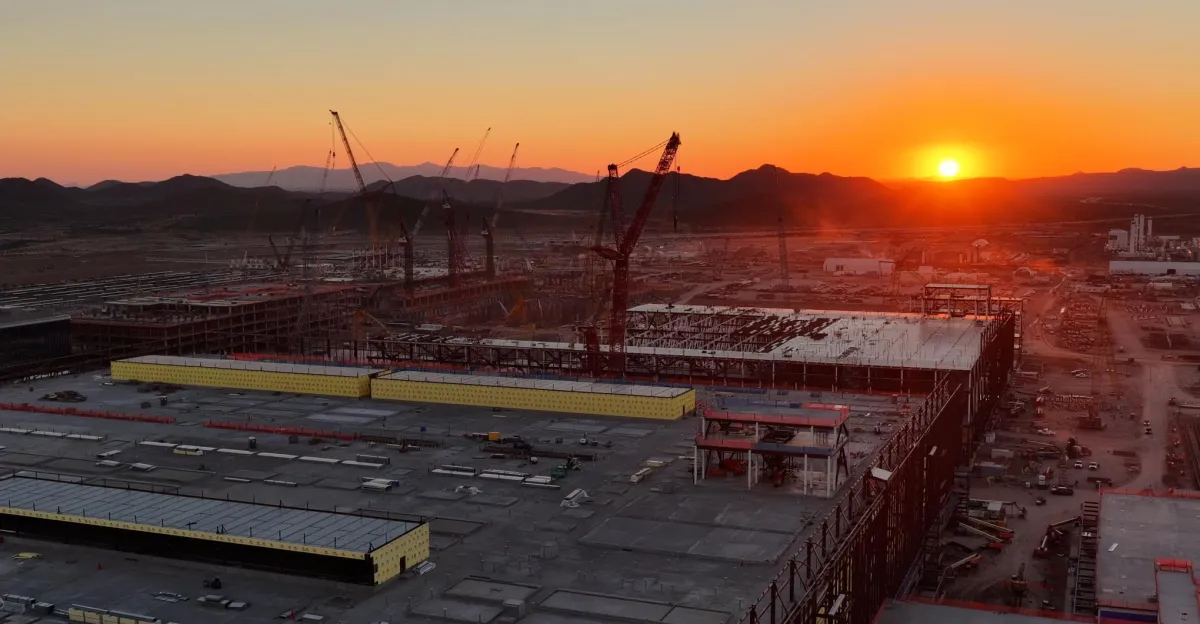
TSMC’s Arizona expansion was widely welcomed when it was framed as a semiconductor win rather than a pure data infrastructure buildout. Phoenix officials treated the company’s arrival as proof that the state could compete for advanced manufacturing on a global scale.
That enthusiasm has not disappeared, but the comparison is now unavoidable. The Verge reported that TSMC’s Arizona operation uses nearly 5 million gallons of Phoenix municipal water every day. The company’s forecasted investment in the state has also ballooned, growing from $12 billion to $265 billion by 2029, according to the reporting, and TSMC says the expansion is the largest foreign direct investment in U.S. history.
TSMC has also brought more than 3,500 jobs to Arizona. For many state leaders, that combination of investment, payroll and industrial prestige made the project politically easy to defend. The public conversation was about strategy and opportunity, not scarcity and sacrifice.
How the TSMC case differs from the current backlash
The difference is not simply the industry. It is the timing, scale and public mood. Arizona has lived through deeper Colorado River cuts, and residents are now more willing to ask what a new megaproject will consume before they ask what it will create.
That is why the same kind of large-scale development that once drew applause can now trigger suspicion. As one local official put it in an older framing of Arizona’s chip pitch, “Now the state has a sixth C, Arizona native Christine Mackay tells me. Chips.” The line captured the optimism of the earlier era. Today, the sixth C is more likely to be contested than celebrated.
Project Blue becomes the flash point in Tucson
The most visible fight is in Tucson, where Project Blue has become a symbol of the new resistance. The Verge reported that the proposed Beale Infrastructure project would sit on a 290-acre site and call for a 600-megawatt build. Early disclosures said it would create 3,000 temporary construction jobs and 200 ongoing jobs, and generate $152 million in tax revenue over 10 years.
Those figures were strong enough to persuade local decision-makers to move the plan forward. The Verge reported that a Pima County memo described Project Blue as an “unprecedented” $3.6 billion opportunity, and the county board voted 3-2 to rezone and sell the land to Beale for about $20 million.
But the project’s economic pitch has been met with growing skepticism. Environmental and community groups argue that Tucson should not trade scarce land and water for a power-hungry facility whose benefits may be narrower than advertised.
“If you feel the heat, please head home.”
The quote, attributed by The Verge to No Desert Data Center Coalition organizer Vivek Bharathan, captures the mood of the opposition: the backlash is not abstract. It is being framed as a demand that companies building in the desert reckon with the desert.
What is driving the backlash?
Arizona’s opposition to hyperscale data centers is being driven by a converging set of anxieties.
- Water: Residents are increasingly focused on how much groundwater or municipal supply new projects will need.
- Power: The electricity demand from large campuses is feeding concerns about rates and grid stress.
- Land use: Local communities are questioning whether industrial-scale facilities belong on valuable acreage near growing cities.
- Growth politics: Voters are more skeptical of the claim that every large project automatically equals broad public benefit.
The water problem is especially acute. The Verge reported that Arizona is expected to lose access to nearly 30% of the Colorado River water it receives. AOL.com, citing Reuters, said the state got a 27% federal cut in Colorado River water supply this year. However the figure is measured, the direction is the same: less water is coming in, and the state’s margin for new demand is shrinking.
Arizona’s broader water policy backdrop makes the alarm even sharper. The Central Arizona Project canal moves Colorado River water to Phoenix and Tucson, but the system is under pressure from the same drought and supply cuts that have defined the region for years. That context has turned what might once have been a technical land-use discussion into a more elemental political argument about how much growth the desert can absorb.
How do data centers fit into Arizona’s growth story?
They fit as the latest and most controversial chapter. Arizona already has 172 data centers in the state, The Verge reported, a sign that the digital infrastructure economy is no longer hypothetical. But once the number of facilities becomes visible, so does the cumulative burden — on power systems, water planning and community patience.
At the same time, the state has spent years selling itself on the old “five Cs” of Arizona industry. Semiconductors are increasingly being described as a sixth. That narrative worked well when it was tied to high-status manufacturing, large payrolls and national security arguments. It is far harder to sell when the industrial buildout begins to resemble an open-ended resource claim.
Why water has become the political center of gravity
Water is now the key issue because it is the most tangible limit on Arizona’s growth. Reuters reporting cited by AOL.com found that water has become central in campaign ads and debates, a sign that the issue has escaped the realm of planning meetings and entered the electoral arena.
That political shift is visible in the language of candidates and advocates. According to AOL.com, Republican gubernatorial candidate Andy Biggs has tried to counter the scarcity narrative with a short, blunt line: “We’re not out of water.” But the broader public mood appears to be moving in the opposite direction, with voters increasingly doubtful that existing systems can keep up with more people, more heat and more industrial demand.
“We can’t continue business as usual”
That warning, attributed to Sarah Porter of the Kyl Center for Water Policy at Arizona State University, reflects what many analysts are now saying more directly: Arizona cannot keep approving growth as if supply conditions were unchanged.
Background: how Arizona got here
To understand the resistance, it helps to trace the timeline. TSMC began shopping for a U.S. site in 2016. In 2019, a Phoenix delegation traveled to Taiwan with a science-and-technology park plan. In 2020, after the pandemic-era demand surge, TSMC announced its Phoenix fab.
Those milestones mattered because they established Arizona as a serious destination for advanced tech investment. The state could point to a real success story, not just a pitch deck. That history helped normalize the idea that massive industrial builds were part of Arizona’s future.
Then the climate, the politics and the scale all changed at once.
By spring 2025, details of Project Blue were beginning to surface. In June 2025, a Pima County administrator submitted a memo to supervisors outlining the project. On August 1, 2025, the No Desert Data Center Coalition staged a protest in Tucson against the Beale site. Reuters then reported, in material cited by AOL.com, that by August 2026 water had become the dominant issue in Arizona election politics.
| Timeline | Event | Why it mattered |
|---|---|---|
| 2016 | TSMC begins shopping for a U.S. site | Marked the start of Arizona’s effort to land a major semiconductor project |
| 2019 | Phoenix delegation visits Taiwan | Helped frame Arizona as a future technology park and manufacturing hub |
| 2020 | TSMC announces Phoenix fab | Turned the state’s semiconductor pitch into a concrete project |
| Spring 2025 | Project Blue details emerge | Set off new scrutiny of large-scale data center development |
| June 2025 | Pima County memo goes to supervisors | Formalized the county’s consideration of the Tucson proposal |
| August 1, 2025 | Tucson protest against Beale site | Showed organized resistance was broadening |
| August 2026 | Water dominates election politics | Confirmed that scarcity had become a top-tier political issue |
What makes Project Blue especially sensitive?
Project Blue sits at the intersection of several contested issues at once. It is large, power-intensive and early in the public approval process, which leaves room for the worst fears to fill the information gap. It is also tied to a land deal that has already created a local political split.
According to The Verge, Tucson Electric Power later said it was studying a rate hike averaging 14%. That does not prove the project will cause customer bills to rise, but it does explain why residents are linking industrial expansion with household affordability. Once utility prices enter the discussion, the fight stops being about one parcel of land and becomes about who pays for regional growth.
The early promises attached to Project Blue also highlight the familiar tension in development debates: large temporary job counts are often used to sell projects, while critics focus on the smaller number of permanent positions and the long-term resource demands. In this case, the proposal’s defenders point to construction work, tax revenue and industrial diversification. Opponents focus on what is missing from the pitch: a clear public accounting of the water source, cooling design and cumulative impact.
What happens next?
The immediate questions are still open. The biggest one is whether Tucson will approve annexation and finalize the Project Blue land sale. Another is what exact water source and cooling design Beale Infrastructure will use, since those details will shape the project’s actual footprint more than any early headline number.
More broadly, Arizona faces a policy reckoning. If voters are this skeptical of growth under current conditions, lawmakers and regulators may have to rethink how they evaluate water-intensive development. That could affect not only data centers but also future manufacturing proposals, utility planning and land-use decisions across the state.
There is also a market question: will Arizona remain a favored destination for hyperscale projects if public resistance keeps rising? The state still has assets that companies want, including infrastructure, business familiarity and industrial land. But the political cost of building in the desert is increasing, and that could change where developers choose to go.
What to watch
- Whether Pima County and Tucson move ahead with Project Blue approvals
- How Beale Infrastructure answers questions about water and cooling
- Whether utility costs, including the Tucson Electric Power review, become a bigger political issue
- Whether other hyperscale proposals in Arizona face similar organized pushback
- How candidates and lawmakers use water scarcity in future campaigns
The larger takeaway
Arizona is not rejecting growth. It is re-pricing it. The state that once welcomed semiconductor investment as a signal of modernity is now asking whether the next wave of digital infrastructure asks too much of a limited desert system. That is the real story behind the fight over Project Blue and the backlash to hyperscale data centers: the old development bargain no longer looks automatic.
For years, Arizona could sell the promise of jobs and capital with relatively little public friction. Now, according to the reporting from The Verge and AOL.com, voters and local officials are pressing a simpler question before they say yes: where will the water come from, and what will it cost everyone else?
Frequently asked questions
Why are Arizona residents opposing new data centers?
Arizona residents are opposing new data centers because they fear the projects will strain water supplies, increase power demand and consume large parcels of land. The backlash is growing as drought and Colorado River cuts make growth feel less affordable and less sustainable.
What is Project Blue in Tucson?
Project Blue is a proposed Beale Infrastructure data center project in Tucson on a 290-acre site with a planned 600-megawatt build. Early disclosures said it could create 3,000 temporary construction jobs, 200 permanent jobs and $152 million in tax revenue over 10 years.
How much water does TSMC use in Arizona?
The Verge reported that TSMC’s Arizona operation uses nearly 5 million gallons of Phoenix municipal water every day. That figure has become a reference point in debates over how much water large industrial projects should consume in a desert state.
Why is water such a big political issue in Arizona now?
Water is such a big political issue because Arizona is facing Colorado River cuts, deep drought stress and growing skepticism that current systems can support more people and industry. Reuters reporting cited by AOL.com says water has become central in campaign ads and debates.